Then he bought the newspapers. London papers ran mocking headlines: “The Duke and the Clerk’s Girl,” “Ravensmere’s Paper Bride.” Satirical prints showed Margaret as an inkpot wearing a wedding veil trailing a duke on a string. Baseless rumors about her past spread from drawing-room to drawing-room, each one uglier than the last. Within days, the ladies who had wished to call at Ravensmere stopped sending their cards.
When Margaret walked into the village, people turned their faces away. She kept her composure and held her head high. Adrian buried himself in work with his solicitor, writing letters, studying statutes, examining every line of the marriage license. But he did not know how to comfort his wife. He did not know what words a husband was supposed to say, and so he said none at all.
His silence widened the distance between them, and each night the long dinner table seemed a little longer. One snowy afternoon, while Adrian was out riding the estate, Reginald arrived at the castle. He wore a yellow waistcoat and a ring on nearly every finger, and he smelled faintly of brandy. He sat down in the drawing-room without waiting to be invited and looked Margaret up and down.
“So, you are the little bride. I expected someone prettier.”
Margaret asked calmly what he wanted. Reginald offered her £500 if she would testify that she had been hired to marry Adrian. Margaret asked what would happen if she refused. The smile slid off Reginald’s face. He promised to ruin her name in every newspaper in England, to shame her family, and to throw her out of Ravensmere the day he won his case.
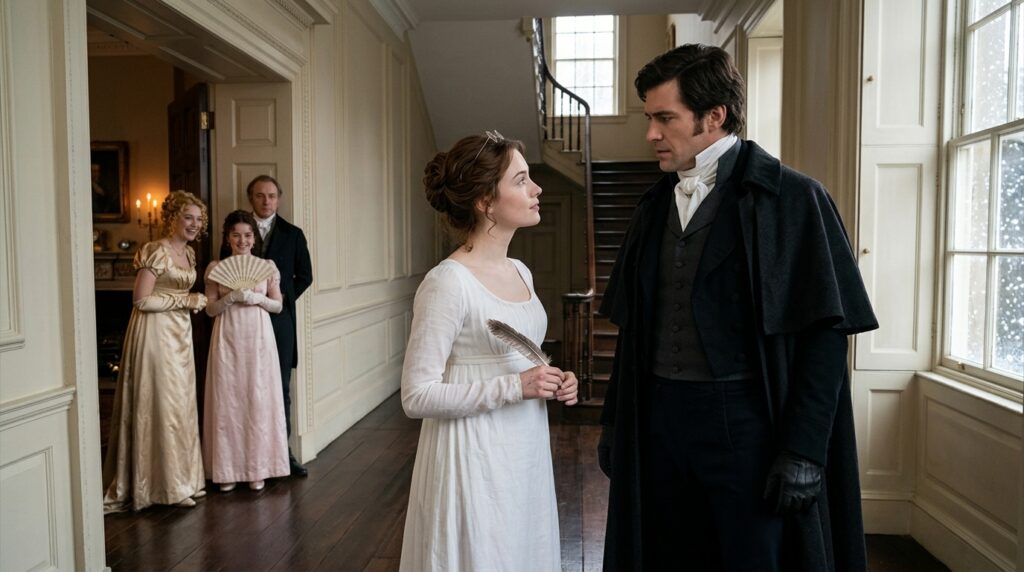
Margaret did not take the money. She rose, rang for the butler, and asked that Mr. Blackthorn be shown out. On his way out, Reginald carelessly left behind a short note he had scribbled for the butler about bringing his carriage around. Margaret picked it up from the hall table.
She looked at the handwriting and something stirred deep in her memory. The tail of the letter Y swept long and curled backward. The cross of the letter T slanted sharply to the left. She had seen that hand before.
She was certain of it. She folded the note and slipped it into her pocket. She could not yet remember where, but the instinct of a woman who had examined thousands of signatures told her this was no ordinary scrap of paper. It might hold the key to Reginald’s entire scheme.
On Sunday morning, Margaret put on her best gray dress and walked to the village church. Snow lay white on the steps and the villagers stood about in small, murmuring groups. As she climbed toward the door, the vicar’s wife stepped into her path. Until the court decided whether the marriage was lawful, the woman said, it might be best if Her Grace did not come inside.











