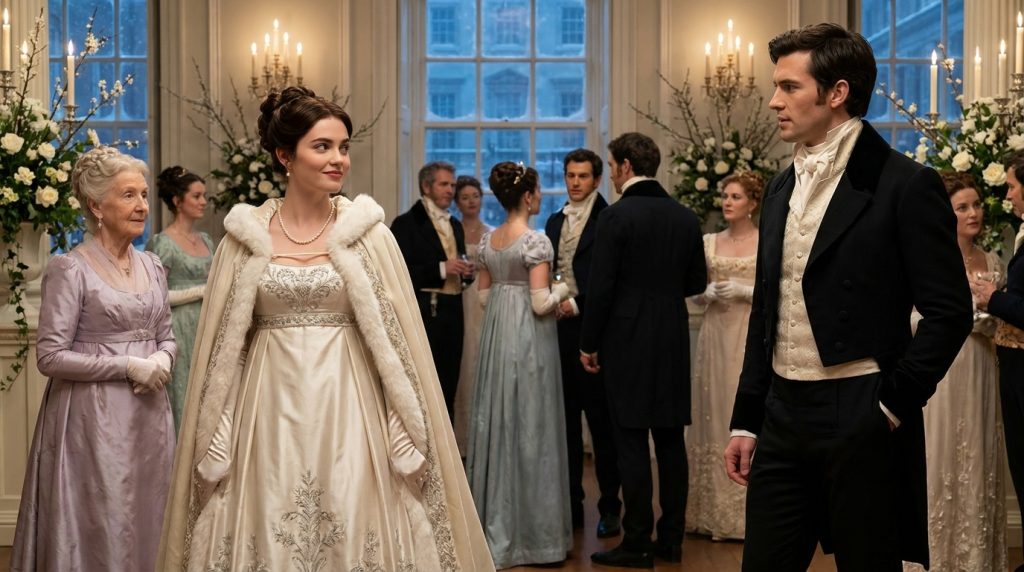
“Miss Vancerstone. Mrs. Kessle.”
The room was full. It was every bit as beautiful as she had known it would be, with its white branches and floating flowers and the long rows of primroses in the windows. People were standing about in it, touching the ivy, saying that they had never seen anything like it. And at the far end of the room, in a dark coat now, with a white cravat and his black hair brushed flat, the Duke of Barntow had turned at the sound of her name.
She saw him look across the room for the stranger his father had promised him to. She saw his eyes find her. She watched him go perfectly still. The lady beside him was still talking. He did not hear a word of it.
He only stood there in the middle of his own ballroom, among the flowers she had put there with her own hands, and looked at Branwin Vancerstone as if the floor had opened under his feet. He came down the room towards her. He did not hurry, and he did not stop for anybody, and the crowd parted in front of him like water in front of a boat. Branwin stood beside her cousin and made herself wait.
One step, two, then he was in front of her, and he bowed very correctly. When he straightened, his face had gone from white to a dull red along the cheekbones.
“Miss Vancerstone,” he said.
“Your Grace.”
She curtsied. Her knees were steady. She was proud of that afterwards.
“You did not leave me your master’s name,” he said quietly, so that only she could hear it. “I was going to write to him.”
“I have no master, Your Grace.”
“No,” he said. “I see that.”
He looked at her a moment longer, at the pearls and the silver net and the hair that her cousin’s maid had dressed so high, and she could not tell what he was thinking at all. Then he turned to Benedicta, who was looking from one of them to the other in pure bewilderment, and made her the kindest bow Branwin had ever seen a duke make to anybody. He said all the right things to her about the journey and the weather. And then he turned back and held out his hand.
“I was told that you came to London to be married to me,” he said, still very low. “I find I was told nothing at all. Will you open the ball with me? It need mean nothing that you do not want it to mean. You have my word on that.”
She thought of her father’s letter lying lost somewhere in this room under the primroses. She thought of all London watching, and she thought quite clearly that if she refused him now in front of everybody, he would bear it without a word, and she would never know what she had refused. She put her hand on his arm. It was a country dance, and it took them up and down the whole long room, so that they spoke in pieces as the figures brought them together and pulled them apart.
“Why did you not tell me?” he asked the first time they met in the middle of the set.
“Because you would have stopped talking to me,” she said.
And then the dance carried her away from him, down the line past a dozen curious faces. When it brought her back, he was waiting with his answer ready.
“Yes,” he said. “I would have.”
He took her hand to turn her, and his hand was warm through both their gloves.
“I would have talked about the weather, and I would not have carried a single urn.”
“Then I’m glad I did not tell you.”
“So am I,” he said, and she was so surprised that she missed her step.
When the dance was over, he gave her back to her cousin, and he was taken away almost at once by a stout old gentleman who wanted to talk about horses. Branwin stood by a pillar wound with her own ivy and let her heart slow down. She meant to find him again before the evening was over. She meant to tell him about the letter. She went over the words in her head.
I came this afternoon to give you something of my father’s, and I lost it among your flowers. It was simple enough, but every time she said it to herself, she heard what came after it. I came to set us both free. And she found that she no longer knew whether she wanted to be set free at all.
“What a delightful room,” said a voice beside her. “One would almost think a country girl had done it.”











