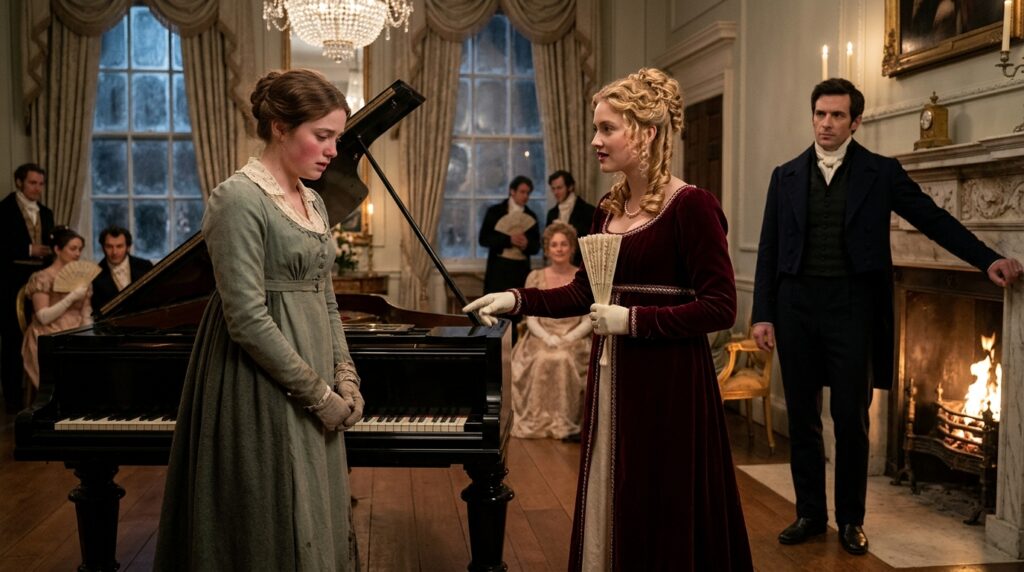
Wincliffe House at noon was a different place from Wincliffe House by candlelight, but it was no smaller. The countess and her daughter were shown up the great staircase and into the duke’s library, a long room walled with books to the ceiling, where the duke stood by the fire with his sister. A third person rose from a chair as they came in. He was a small, stooped, white-haired man in a black coat and Dorothea, seeing him, stopped on the threshold.
“You know Lady Dorothea’s music master, I think,” said the duke. “I took the liberty of asking him here. He has taught my sister’s daughters these 10 years and before that he was for some time at a church in the city under an organist of whom he speaks very highly.”
Imogen came in last carrying nothing. Two of the duke’s footmen followed her with a small, battered trunk between them. They set it down on the turkey carpet and withdrew.
“Lady Dorothea,” said the Duke, “you have said that the air played here on Thursday night was composed for you by this gentleman. Have you the manuscript?”
Dorothea produced a sheet of music in her own neat hand headed “Air composed for Lady D.” She had sat up most of the night writing it out from memory and it was not perfectly accurate. The music master took it. He looked at it for a long time. Then he laid it down on the table and folded his hands and his face was very gray.
“Your Grace,” he said. “I did not write this. I could not write this. I have been paid a guinea a lesson for two years to tell Lady Dorothea she plays well and God forgive me, I have told her so. But I will not stand in a Duke’s house and claim another man’s work. I knew the man who wrote that air. I turned his pages. He was the greatest musician I ever met and he died owing the candle maker.”
There was a silence. The Countess had put her hand to her throat.
“Miss Ridley,” said the Duke gently, “the trunk.”
Imogen knelt and opened it. It was full of music, hundreds of pages brown at the edges all in the same strong slanting hand. She found the one she wanted without searching because it lay on top where she had kept it for three years. She laid it on the table beside Dorothea’s copy. It was written on paper that had been folded many times.
At the top in that slanting hand were the words “Air for my wife” and the name Ridley and the date April 1809. There were corrections in the margins. On the last page under the final chord was written in a girl’s round hand “Papa, I can play it now” and the date 1810. The music master touched the paper with one finger and his eyes filled.
“There is one thing more,” said the Duke, “and it is my own testimony. On the evening of the 7th of March, I walked home from a dinner past the Countess’s house and heard that air played through an open window. I heard it again on the 9th and the 11th. I should like to ask Lady Dorothea where she was on those three nights.”











