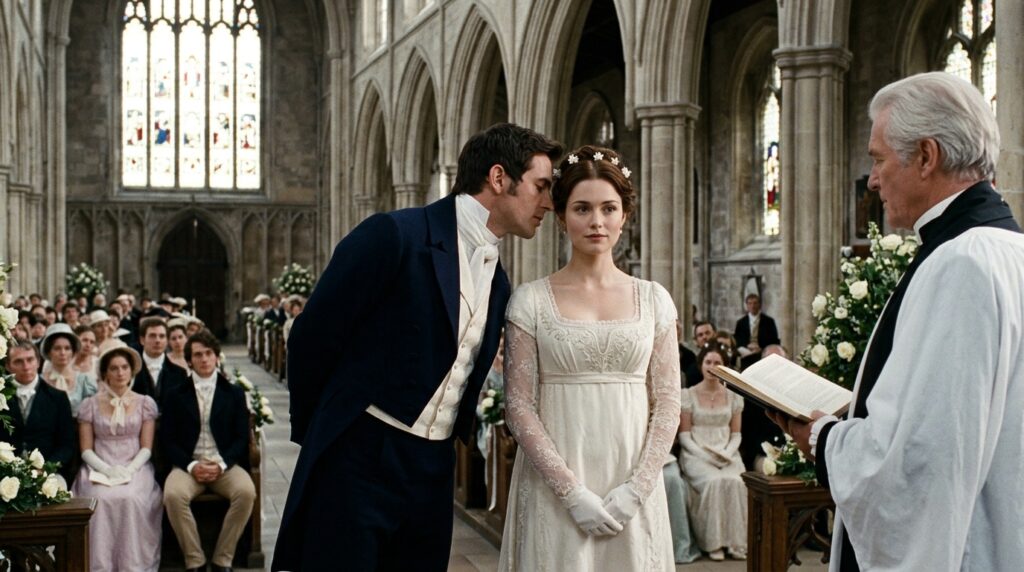
It was Lady Saxby who forced the matter into the open. Six weeks after the wedding, at a dinner hosted by the Countess of Harlow, Lady Saxby addressed Emmeline directly for the first time.
“Tell me, Your Grace,” she said, and the title dripped from her mouth like something distasteful, “is it true that your father mends his own boots? I heard it from Lady Pomeroy, who heard it from the curate at Fullwood. Such a charming detail. One so rarely meets a duchess whose family maintains their own footwear.”
The table quieted. Emmeline set down her glass.
“My father,” she said, “mends his boots because he believes that wastefulness is a sin. He also believes that a man’s character is better measured by what he repairs than by what he discards.”
She paused.
“I have always found that principle useful.”
Lady Saxby’s smile thinned but held.
“How delightful. And does the Duke share this philosophy?”
Lucian’s voice came from the head of the table, not loud but carrying.
“My wife’s father is a man of greater principle than anyone else in this room, Lady Saxby, including myself.”
He lifted his glass.
“A quality I intend to learn from.”
The silence that followed was exquisite. Lady Saxby did not speak again for the remainder of the evening. The Countess of Harlow changed the subject with the practiced efficiency of a woman who had been defusing social explosions for 30 years. The dinner continued and Emmeline ate her food and did not look at her husband. She felt something behind her ribs that she was not yet prepared to name.
In the carriage home, the horses’ hooves beat a steady rhythm against the road and the summer darkness pressed against the windows. They sat in silence for several minutes. Emmeline watched the hedgerows pass as black shapes against a sky that still held the faintest memory of daylight at this hour in July. She was aware of her own heartbeat and of his breathing. She felt the strange intimacy of a shared carriage after a public evening when the performance drops away and what remains is simply two people and the things they have not yet said.
“Thank you,” she said.
“I did not say it for you.”
He paused.
“I said it because it was true.”
“Those are not mutually exclusive.”
He turned his head. In the darkness of the carriage with only the lanterns outside casting shifting light across his features, he looked younger than his 34 years and more uncertain. She understood that this was the version of him that existed when no one was watching. The version that did not know how to be anything other than the Duke and was only now discovering that he might also be something else.
“Emmeline,” he said.
It was the first time he had used her Christian name without the prefix of formality.
“Yes?”
“I am glad you stopped the wedding.”
She looked at him.
“Are you?”
“If you had not, if you had simply said your vows and submitted, I would have spent this marriage believing I had a wife who agreed with me in all things. I would never have known that I had a wife who could disagree with me and still remain.”











