“He always said you had the better head for figures,” Mrs. Pell murmured from the doorway, wringing her apron. “Better than any son.”
“He promised me the estate would be in good hands,” Nora whispered. “He said it was all arranged.”
She believed it because her father had never once broken his word.
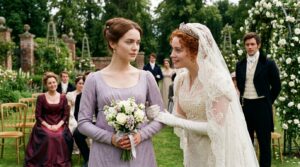
The funeral passed in a blur of black crepe and polite condolences. Lucinda, her stepmother of only two years, wept beautifully into a lace handkerchief, while Cordelia, 17 and pink-cheeked, clung to her arm and received sympathy from every guest. Nora stood a little apart in a borrowed gown, and no one noticed that her hands were shaking.
Three days later, the solicitor was summoned to the drawing room. Nora took the chair nearest the window, certain of what she would hear. Mr. Aldridge cleared his throat, unfolded a document, and avoided her eyes with a care that made her stomach tighten.
“The last will and testament of Lord Edmund Hartwell,” he began. “Hartwell Park, its rents, its funds, and all its properties to his beloved daughter, Cordelia Vane Hartwell.”
The words made no sense. Nora heard them the way one hears a language from childhood, familiar in sound but strange in meaning.
“There is a mistake,” she said. “My father would never…”
“It is signed and witnessed, Lady Eleonora.”
Mr. Aldridge turned the page toward her. The signature was nearly her father’s, nearly. The loops were too eager, the final stroke too confident, as if written by someone who had practiced.
“That is not his hand.”
“Nora.”
Lucinda’s voice was soft as cream.
“Grief makes us see monsters everywhere.”
“I know my father’s hand.”
“Do you?”
Lucinda rose and crossed to her, resting a cool palm against her cheek.
“Be sensible, dear. You are fortunate. Many girls in your position would be sent away with nothing. I am allowing you to stay. A roof, a bed, a place at the table. You should be grateful.”
Cordelia smiled behind her mother’s shoulder. It was not the smile of a girl who was surprised. Nora said nothing. She understood, with a clarity that frightened her, that no one in that room would take her side. She had no proof, no money, and no one to ask.
That night, she sat in the dark of her old bedroom, now a servant’s cell beneath the eaves, listening to the rain. A soft knock came. Mrs. Pell slipped inside, pale and trembling, and pressed something cold into Nora’s palm. A small brass key.
“I cannot say more,” the old woman breathed, glancing at the door. “But your father did not leave this world without a plan, my lady. The real one is still in this house.”
Nora closed her fingers around the key and held it as tightly as a promise.
The first year taught Nora how quickly a person could be rearranged into furniture. She rose before the maids to lay Lucinda’s fires. She took her meals after the family had finished, at the end of the kitchen table, where the cook slipped her the heel of the bread and said nothing. By the second winter, Lady Eleonora had shrunk to Eleonora, and by the third, to “Nora, fetch my shawl.”











