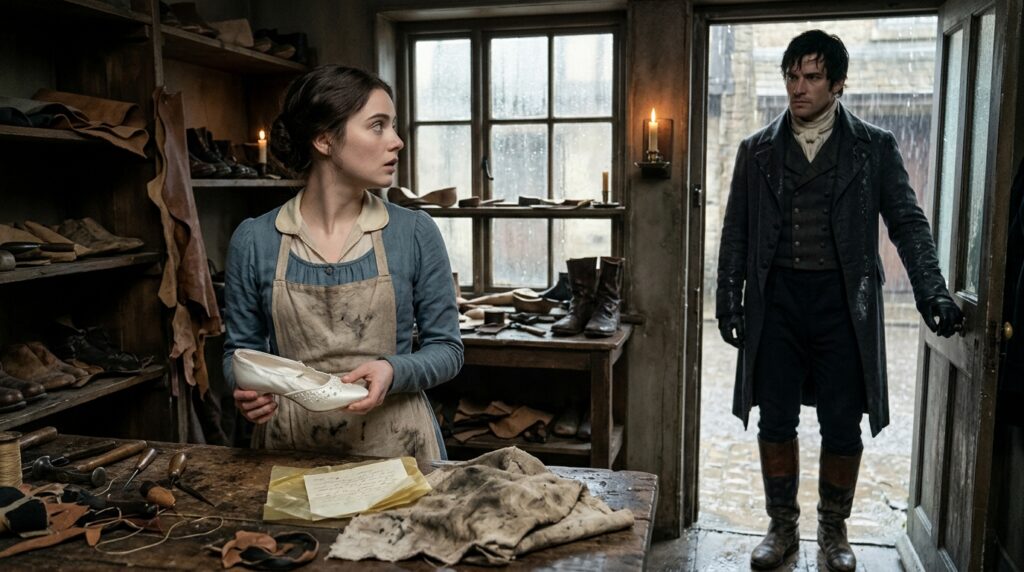
The bride’s shoes were never worn until the cobbler’s daughter lifted the insole. For eight long years, a pair of white satin wedding shoes sat in a locked trunk at Ravensworth Hall. They had been made for a bride who never walked down the aisle. The family said she ran away in the night with a man no one could name.
The servants were told never to speak of her again. Her portrait was taken down from the gallery wall and turned to face the plaster in an attic room. And the old cobbler, who had made those shoes, lost his voice, the use of his right hand, and very nearly his life, all within a single week of her disappearance. No one ever thought to ask why.
Not until a cold, rainy afternoon in the autumn of 1819, when the cobbler’s daughter took a thin silver blade, slipped it beneath the satin lining of the left shoe, and gently lifted the insole. What she found hidden there would bring a proud duke to his knees. It would tear the smiling mask from the face of a woman everyone believed was a saint. And it would open a door that had been locked, bolted, and forgotten at the far edge of England for eight long years.
The little town of Ashbury sat in a green fold of the Wiltshire hills, with a crooked high street and a church with a leaning spire. At the bottom of that street, beside the baker’s, hung a faded wooden sign, “T. Hartley, bootmaker.” For 30 years, Thomas Hartley had made the finest shoes in three counties.
He was a quiet, broad-shouldered man with gentle gray eyes and hands so steady that people said he could stitch a seam straight in the dark. But Thomas Hartley had been dead since the snows of last January. And now the little shop belonged to his daughter.
Eleanor Hartley was 24 years old with her father’s gray eyes and her late mother’s dark hair pinned plainly back. Her hands were rough and there was always a faint smell of leather and beeswax about her. But when she smiled, which was not often anymore, her whole face changed the way a dark room changes when someone opens the shutters. Everyone in Ashbury called her Nell.
And everyone in Ashbury, it seemed, had decided that a young woman could not possibly make a decent pair of boots. One by one, her father’s customers had drifted away to Salisbury and to London. All that remained for Nell were the mending jobs, a crooked heel, a split seam, a child’s shoe chewed by a puppy.
She did every one beautifully and she was paid in pennies. The rent was 3 months overdue. And the rent, like nearly everything else in Ashbury, was owed to the estate of the Duke of Ravensworth.
The bell over the shop door rang at a quarter past four. Nell looked up from the boot she was resoling and felt her stomach tighten. The man who stepped in out of the rain was tall and thin with a long pale face and small careful eyes that seemed to count everything they rested on. Water dripped from his umbrella onto her clean floor. Mr. Silas Crane, steward of Ravensworth Hall for 15 years, the man who collected the rents and decided which tenants stayed and which were turned out onto the road.











