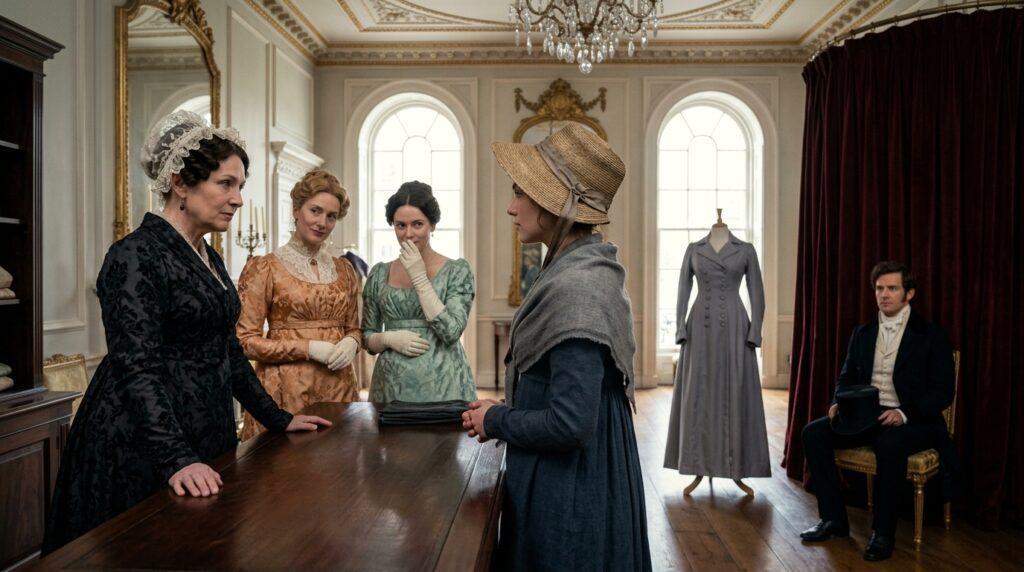
“I don’t like seeing good work thrown away,” he said, hearing how thin it sounded, and he didn’t try to give it any more weight.
She folded the invoice along its old creases and put it into her reticule.
“Good day, Your Grace,” said Miss Alicia Sanford, and she walked away down the Strand.
He rode home. Paxton House stood in the square behind Piccadilly. A tall, light-colored house with a fanlight over the door, looking like a half-opened fan. His great-grandfather built this house to be admired. Damian grew up in it.
His father was a very great man. So everyone said. He sat on four committees in the House of Lords, and no one ever heard him change his mind about anything. Once, on one of the rare occasions when he spoke to his son for longer than a minute, he told him that a Duke of Paxton should be like this house: motionless, pale, beautiful on the outside, and bolted shut.
“People will want to enter,” his father said. “Do not let them in. They only want what is inside.”
Damian took it to heart. For a long time, it was the only advice he had. Barbara returned home an hour later in a fury.
“You abandoned me in the fitting room,” she said, standing in his study doorway with her hat in her hand, sleeves pinned up, and her bodice unfastened at the back. “And Madame Varnier is in such a state, you wouldn’t believe it. She was crying, Damian, real tears. She said you were deceived by a wicked girl who has been robbing her workshop for years.”
“You believed her?”
Barbara opened her mouth, closed it, stepped inside, and sat in the chair opposite his desk.
“No,” she said. “Of course not. I remembered the girl with the pins, the one who drew me a sleeve on the back of an invoice. I asked her then, did Madame come up with this? And she didn’t say, ‘Yes.’ She only said, ‘Madame will decide.'”
Barbara looked at him.
“Was that her?”
“Yes.”
“There in the shop?”
“Yes.”
“So, Madame Varnier was passing off her work as her own?”
Barbara’s eyes widened.
“Damian, half the dresses in London.”
“Yes.”
“And you said it out loud? In front of Lady Selincourt?”
“I did.”
His sister stared at him for a long time, as if seeing something in his face she hadn’t noticed before. And that night he lay awake in the massive carved bed where his father had died, listening to the night watchman calling out the hours in the square. And every time he closed his eyes, he saw the young woman in the simple blue dress at the shop counter, asking what nine shillings turn into when they end up in the display window. And somewhere around three in the morning, he sat up in bed and said aloud, into the void:
“Well, of course.”
In the morning, he called for Barbara before breakfast.











