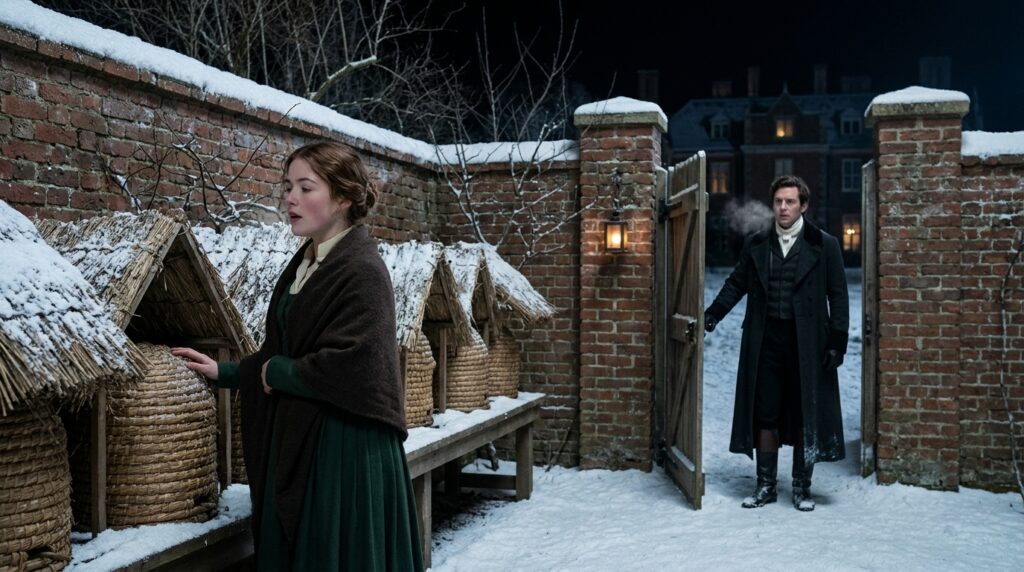
The honey jars stood in a long row on the stillroom table, and every jar had a name on its lid. Rosamund Marthorp had chalked the names herself the night before, in her careful round hand. There was the widow at the bottom of the lane, the shepherd’s cottage, the family by the pond whose roof leaked, the old man who lived alone above the hop garden. She had done it the way it was done every year at White Hold.
A jar of honey for every cottage on the estate, with the beef and the coal and the loaves, given out at the back door on St. Thomas’s day, the short, dark day before Christmas. She was tying the last string when the door opened behind her, and the cold came in.
The Duchess did not knock. She never did. She stood in the doorway in her black silk, a year of mourning on her and no sign of putting it off. And she looked at the jars the way a person looks at a mess on the floor.
Lucricia, Duchess of Orleton, was 30 years old and handsome still, though her face had gone thin and sharp in the year since her husband’s death. The steward stood behind her with a paper in his hand. He did not meet Rosamund’s eyes.
“Read it to her,” Lucricia said.
The steward cleared his throat. His grace, he read, had given orders that Christmas would not be kept at White Hold this year. There would be no greenery brought into the house, no candles set in the windows, no Christmas dinner in the hall, no dance for the servants, and no carols sung. That was all.
He folded the paper again as though it had burned him a little. Rosamund stood with the string still in her fingers. She thought of the old man above the hop garden who had nothing to burn but what he could pick up in the wood.
“And the dole, Your Grace?” she said. “The coal for the cottages and the beef.”
“His grace said no Christmas.”
Lucricia came a step into the room. She lifted one of the jars and read the name on the lid and set it down again.
“Christmas is a feast. A feast is what we give. Take these down to the cellar, all of them, and lock the door. Then go to the back door. The village women will come on Saturday to ask about St. Thomas’s Day, as they do every year. You will tell them there is nothing.”
She paused and her voice did not change.
“You are from the village. They will take it better from you.”
So Rosamund carried the jars down. It took her four journeys on the cold stone stairs with the names turned in against her apron so she would not have to read them. She locked the cellar door and gave the key to the steward because the duchess had already gone.
On Saturday, the women came up the yard in their shawls, eight or nine of them, stamping their feet against the ice, and Rosamund opened the door and told them. She said it plainly. There was no kinder way to say it. Nobody shouted.
That was the worst part. They simply stood there and took it the way they took the weather. And then the oldest of them pulled her shawl tighter and said,











