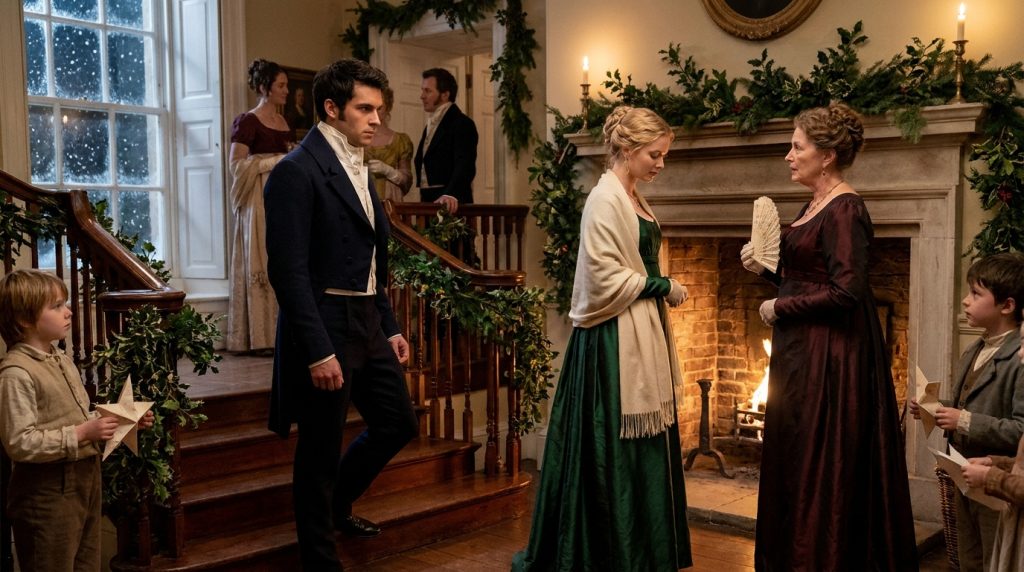
The Duke of Ashcombe had chosen his bride with the same care he gave to replacing a broken gate. She must be suitable, dependable, and unlikely to disturb the orderly machinery of his life. Love was not mentioned in the agreement. Love, in Sebastian Vane’s experience, was the name people gave to an enthusiasm that made them careless with everything worth keeping. On the morning his future wife arrived at Blackthorn Hall, he was standing in the library beside a cold fireplace reading the final provisions of their marriage settlement.
The last page assigned Lady Eleanor Whitmore an annual allowance, apartments in the east wing, and unrestricted use of the gardens. It said nothing about happiness. Sebastian considered that an advantage. His solicitor, Mr. Henshaw, cleared his throat.
“Her carriage has passed the south lodge, Your Grace.”
“Then the arrangement begins,” Sebastian answered, and signed his name.
At 29, Eleanor Whitmore was no longer considered a promising bride by the drawing rooms of London. Her father had died with debts concealed behind a magnificent reputation. Her younger brother had inherited the debts, but not the reputation. And their aunt, who had been feeding Eleanor for 3 years with a generosity she counted aloud at every meal, had informed her that marriage to the Duke of Ashcombe was a mercy she ought to accept without asking unnecessary questions. Eleanor had accepted, though not because she mistook the offer for mercy.
She had learned long ago that a woman with neither money nor powerful relatives could not always choose the door through which she entered her future. She could, however, decide what sort of person would pass through it. As her carriage came up the long drive, she studied the mansion through the misted glass. Blackthorn Hall stood above the valley like a fortress that had forgotten what it had been built to protect. Rows of narrow windows watched the lawns.
A stone fountain stood dry beneath a coating of dead leaves. The building was immense, handsome, and entirely without welcome. Eleanor pressed her gloved hand against the parcel on her lap. It contained her mother’s sewing box and a small blue notebook, the only possessions she had refused to let her aunt sell.
“Well,” she murmured, “we shall see what can be done with you.”
Sebastian met her beneath the portraits of six generations of men whose faces were arranged in different degrees of disapproval. He bowed precisely. She curtsied precisely. Neither performed the slightest movement more than necessary.
“Lady Eleanor, I trust your journey was tolerable.”
“Very tolerable, Your Grace. We crossed only one collapsed bridge and encountered no highwaymen. An excellent day by modern standards.”
He looked at her. He was accustomed to ladies using their first meeting with him to discuss the weather, their accomplishments, or his celebrated estate. He had not expected a collapsed bridge to be presented as good fortune.
“You are tired,” he concluded. “Mrs. Bell will show you your rooms.”
“Thank you. Before I go, might I ask whether the bridge on your southern road has been repaired?”











