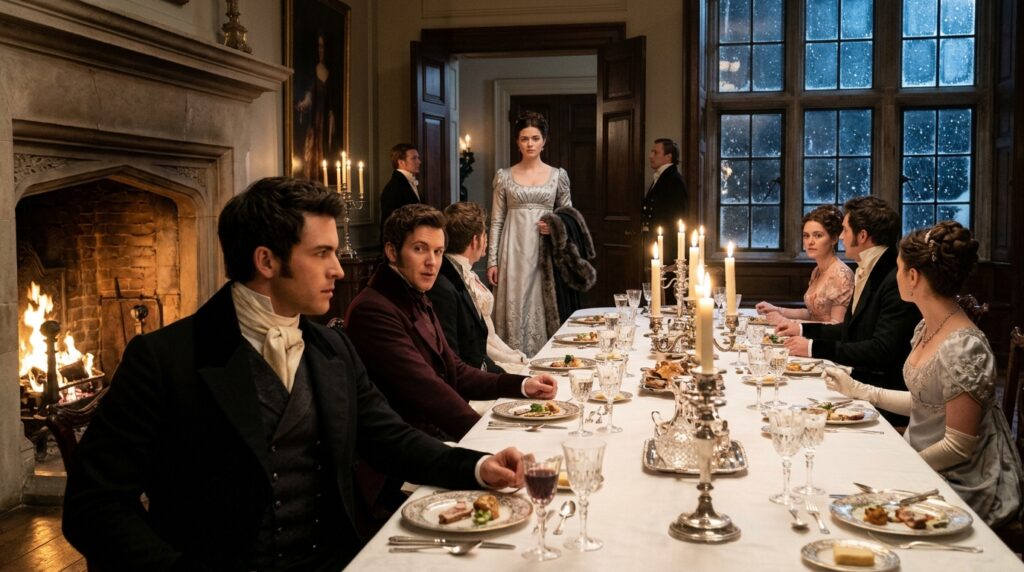
The joke was simple. Invite the dirtiest, lowest chambermaid to the grandest dinner of the season. Watch her humiliate herself and have a good laugh over brandy. Gideon Hale, the Duke of Westford, made the wager out of sheer, suffocating boredom.
But when the dining room doors swung open, the laughter died in their throats. She didn’t come in rags. She came in a ruined dynasty’s silk, wearing it like armor. And suddenly, the Duke wasn’t laughing at all.
Rain lashed against the tall, mullioned windows of Oakhaven. It had been raining for 3 days. Inside the drawing room, the air was thick with the smell of stale port, damp wool, and the suffocating boredom of men who had never been forced to do a day of actual work in their lives. Gideon Hale, the Duke of Westford, stared at the cards in his hand and felt absolutely nothing. He was 30 years old, possessed a fortune that could buy a small European nation, and he was dying of sheer apathy.
“I tell you, the entire season is a wash,” Lord Croft drawled, slouching in a wingback chair.
Croft was a man whose wealth barely concealed his profound lack of character. He possessed a cruelty that only the truly insulated could afford.
“The women are dull, the horses are slow, even the scandal is tedious.”
Gideon tossed his cards onto the green baize table.
“You lose, Croft.”
Croft scowled, pushing a stack of banknotes toward Gideon. He looked around the room, desperate for a distraction. His eyes caught movement in the hallway, just beyond the open double doors. A maid was kneeling on the cold marble floor. She was cleaning the massive iron grate of the hallway fireplace.
It was filthy, backbreaking work. Even from a distance, Gideon could see the gray smear of soot across her pale cheek. Her dress was a coarse, homespun gray, practically entirely devoid of shape, and hemmed with damp dirt. She scrubbed at the iron with a stiff-bristled brush, the harsh sh, sh, sh sound carrying into the silent, velvet-lined drawing room.
“Look at that miserable creature,” Croft sneered, sitting up slightly.
A vicious little spark lit in his eyes.
“I wager she doesn’t even know what a dining fork looks like. Probably eats with her hands.”
Thomas Linley, sitting to Gideon’s left, laughed. It was a thin, papery sound.
“I wager she’d faint if a gentleman so much as spoke to her.”
Gideon looked at the girl. She paused her scrubbing, lifting a hand to push a stray lock of dark hair out of her eyes. Her knuckles were red and raw. There was a rigid, mechanical efficiency to her movements.
She wasn’t a person to these men. She was part of the furniture. A fixture of the estate, like the grandfather clock or the hunting hounds.
“I have an idea,” Croft said, his voice dropping to a conspiratorial whisper. “£50 says you can’t get her to sit at the table with us tonight, Gideon.”
Gideon slowly turned his head.
“To dinner?”
“Yes. The grand dinner. Lady Hastings has brought out the good silver and the French chef. Invite the soot girl. Tell her it’s a special reward from the master of the house. She’ll show up in her pathetic little rags, thinking she’s been elevated, and we’ll have a bit of sport.”
Gideon stared at Croft. It was a vile idea. It was base, cruel, and utterly devoid of honor. A gentleman should protect those beneath him, not drag them out for mockery.
But the boredom was a physical weight on Gideon’s chest, and a darker, more cynical part of him wondered what it would take to break the suffocating monotony of his existence. He was surrounded by sycophants. Everyone wanted something from him. What would this girl want?











