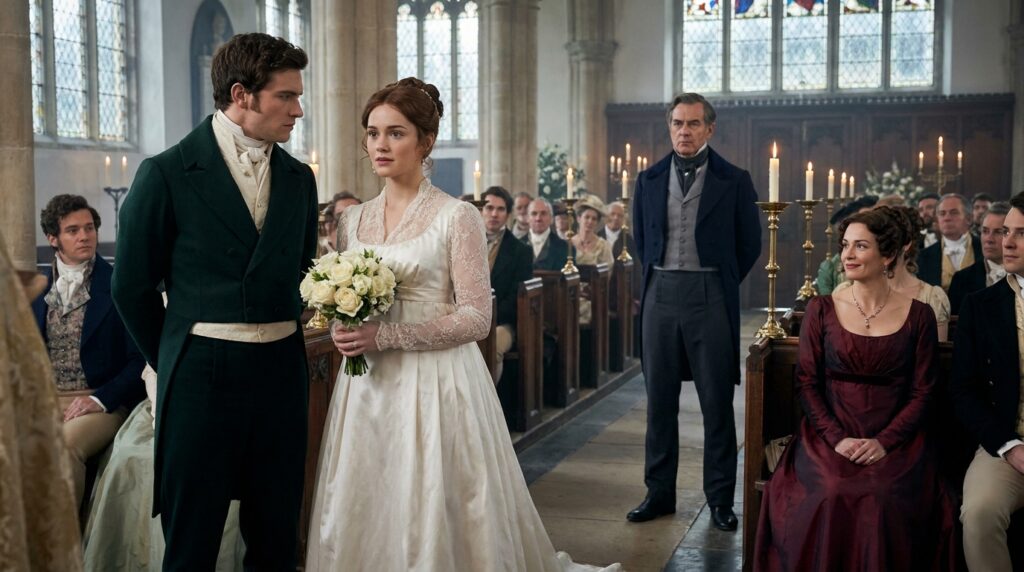
The Duke’s son had chosen the cruelest possible moment to refuse his bride. The church was full, the candles had been lit, and Lady Eleanor Vale stood at the altar with a spray of white roses trembling in her gloved hands. This was when Lord Julian Ashcombe announced quite clearly that he would not marry her. He did not speak to Eleanor. He addressed the congregation as though she were an unfortunate clause in a contract he meant to strike out.
“I have discovered that I cannot bind my future to a woman I do not love,” he said.
A murmur swept the pews. Then Julian turned to the young widow seated beside his friends and offered her his hand. Eleanor watched Lady Cecily rise. She watched Julian smile at Cecily in a way he had never smiled at his intended wife.
What Eleanor remembered afterward was not the laughter, though someone laughed, nor the scrape of chairs, nor even her mother’s sharp intake of breath. It was the sound of a rose stem snapping between her fingers. Across the aisle stood the Duke of Ravenswick, Julian’s father, wearing the grave expression of a man who had just seen a house he built catch fire. He did not look at his son. He looked at Eleanor.
“You will apologize,” the Duke said.
Julian shrugged.
“For speaking the truth?” he asked.
“For making a spectacle of a woman who trusted your word,” the Duke demanded.
“That is an old-fashioned sentiment, Father,” Julian said.
“Honor generally is to those who possess none,” the Duke replied.
The words fell into the church with a weight no whisper could lift. Julian flushed, but his pride was stronger than his embarrassment. He led Cecily toward the door. The Duke moved aside to let them pass, and Eleanor understood that the wedding was over. Only then did she discover she could no longer feel her fingertips.
She had been engaged to Julian for 14 months. During that time she had learned to answer his careless jokes with patience, his sudden absences with excuses, and his mother’s chilly remarks with a composure praised by everybody who had never been required to possess it. She had believed affection might grow in a marriage if two people were kind enough to give it room. Julian had offered neither kindness nor room. Still, on the morning of the wedding, she had risen hopeful, because hope sometimes survives long after evidence has died.
Now the guests streamed out, careful not to look at her until they were far enough away to stare. Her mother remained frozen in the first pew where a duchess’s title had seemed so close an hour earlier. Her father had died leaving a modest estate, a respectable name, and debts that courtesy did not pay. Eleanor understood precisely what the ruined wedding would cost her family.
No one would say the rejection was her fault, but everybody would wonder what fault had been discovered. That was how society punished a woman. It supplied the accusation itself, then demanded she disprove it. The Duke of Ravenswick came to stand beside her.











