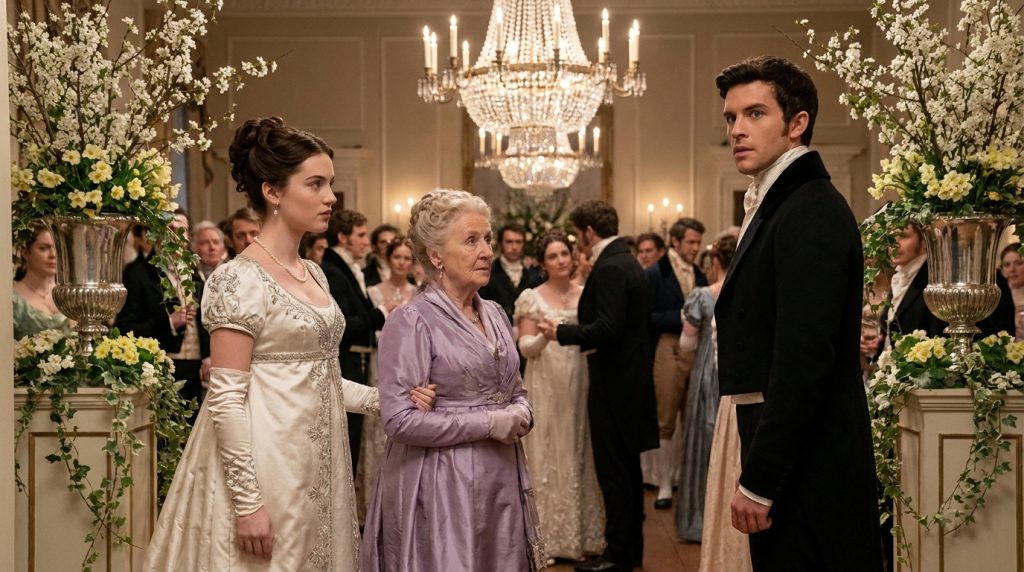
The Duke Mistook Her for House Staff—Hours Later, She Walked into His Ballroom as an Heiress
“The first dance, Branwin. He means to open his ball with you in front of all London. And once a duke has led a girl out first in his own house, there is nothing left for anybody to decide.”
Cousin Benedicta said it with her hands clasped under her chin and her cheeks pink, as if she were announcing a legacy. The letter that had told her lay open on the breakfast table between the toast rack and the marmalade. It was written in the sloping hand of an old friend who knew everybody in Mayfair and had nothing to do but write about them. Branwin Vancerstone set her cup down very carefully in its saucer.
Outside the window of the rented house in Mount Street, the March wind was throwing grit against the glass and bending the bare plane trees almost double. It had blown like that since before dawn. In Cornwall, a wind like that meant the boats stayed drawn up on the shingle, and the women watched the sea from the cliff path. Here, it only meant that the ladies of Mayfair would arrive at tonight’s ball with their curls undone. She looked at her cousin’s happy face and found that she could not speak at all.
“You knew he would ask you to dance,” Benedicta said, a little less certainly.
“I knew he would be civil,” Branwin said. “I did not know he meant to settle it before I had even seen his face.”
She stood and went to the window. The square below was all dust and blowing straw, and a boy was chasing his hat across the cobbles. She was 22 years old. Her father had made her swear not to wear black for him past the winter, so she had come up from the coast with her black gloves barely put away, with her father’s fortune in her name, and her father’s promise round her neck like a stone. And tonight, it seemed, the stone would be fastened there for good.
The promise was older than she was. Everybody at home knew the story because her father had told it in every tavern between Porth Carrow and Truro. A young lord had gone sailing in March when he should have stayed ashore. The wind had turned the way it did and put his boat on the rocks under the cliffs. A fisherman’s son had gone down the cliff on a rope and swum out through water cold enough to stop a heart and brought him back alive.
The young lord had become the Duke of Barntow in time. The fisherman’s son had become a mine captain and then the owner of a mine and then a rich man who built a white house called Silvercourt on the cliff above the cove. And between them, on a sheet of paper written in a wet hand at a cottage fire, there was a promise. If one of them had a son and the other a daughter, and the two would have each other, the houses would be joined.
Both men were dead now. The old duke had died two winters ago. Her father had died early in this last one, in the front bedroom at Silvercourt, with the sea gray in the window and her hand in his. And a few weeks later, a letter had come from London, from the new duke, a man she had never met. It was a short letter and a correct one.











