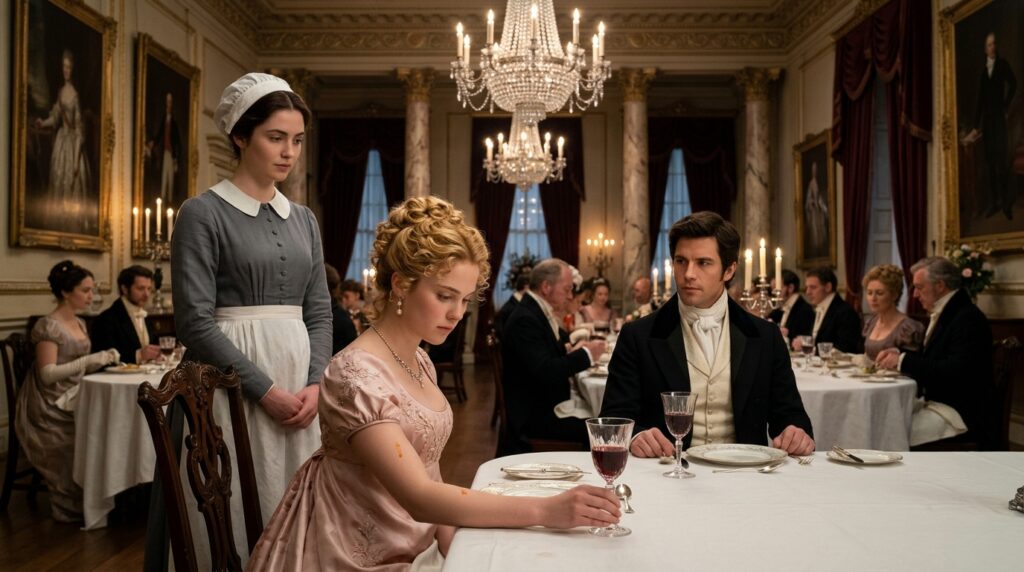
The glass of red wine hit Margaret Fenwick full in the face. It ran into her eyes, down her chin and over the white collar of her dress. For one long moment, the great dining room at Ashcombe Park was completely silent. Then somebody laughed. But to understand that moment, you must go back.
You must know who Margaret Fenwick was and why she had come to that house in the first place. Margaret was a lady’s maid at Ashcombe Park. She was 24 years old with dark brown hair pinned tight under a plain white cap and gray eyes that saw far more than they ever showed. She woke before the sun. She lit the fires, pressed the gowns, brushed the hair, and carried the trays.
She said, “Yes, my lady,” and “No, my lady,” a hundred times a day. To everyone in the house, she was nobody at all. But Margaret had not always been poor. Once not so long ago, she had lived in the house on the next hill. It was called Fenwick Grange.
It was not as grand as Ashcombe, but it was warm and full of books, and it had the best green fields in the whole valley. Her father, Thomas Fenwick, had owned that land, and his father before him, and his father before that. Then, 5 years ago, Lord Ashcombe had come to court with a piece of paper. The paper said that Thomas Fenwick had sold his land to Lord Ashcombe years before for a small sum and had simply never left. It was a lie.
Margaret knew it was a lie. Her father knew it was a lie. But the paper had a signature on it that looked very much like her father’s hand. And Lord Ashcombe had money, friends, and a clever lawyer. Thomas Fenwick had only the truth.
The judge gave the land to Lord Ashcombe. Her father never recovered. He grew thin and gray and quiet. He kept saying the same words over and over.
“I made a will, Maggie. I made a will and I kept the deed safe. They are somewhere. If we only had them, we could prove it.”
But the papers were gone. The house had been emptied by Lord Ashcombe’s men the day they were thrown out, and every drawer and box had been carried away. 3 months later, her father died in a small rented room in the village holding Margaret’s hand. Margaret had no money, no family, and no home. So she did the only thing she could think of.
She changed her name to Margaret Fen, put on a plain dress, and walked up the long drive of Ashcombe Park to ask for work. If her father’s papers still existed, they were inside that house. She was certain of it, and she would find them no matter how long it took. That had been four years ago. Now she served Lord Ashcombe’s only daughter, Lady Sybil.











