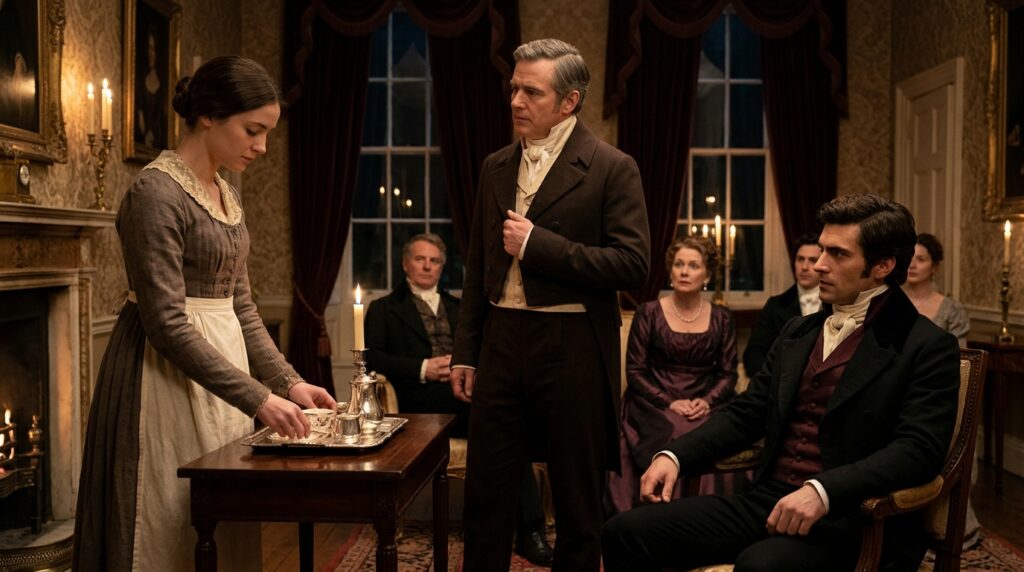
The back room of the Ashby house only received light in the early morning hours. Beatrice Fairfax woke before the kitchen bell, as she always did, with the kind of calm that comes not from rest, but from habit. The ceiling was low and the window small, and the October chill had already conquered the thin blanket. She lay still for a moment before getting up. On the windowsill sat a jar of dried herbs, thyme, lavender, and a sprig of immortelle she had gathered the previous autumn.
It was the only touch that belonged to her in that borrowed room. Everything else belonged to the house, to the Ashbys, to the trade. From the pocket of the apron folded over the chair, Beatrice pulled out the worn leather wrap. Inside was a letter, three pages of yellowed paper, small handwriting, with folds so deep the lines barely needed a guide anymore. It was the last letter her father had written in the weeks before he left.
She had carried it with her for three years. She lit the tallow candle with a match kept in the drawer and read the final lines in silence, as she always did when the day promised to be heavy. She knew the words by heart, but there was something different about seeing them with her own eyes. “You are more than the place they put you in.”
She folded the letter slowly, tucked it into her pocket, and went down to the kitchen before anyone else was awake. The hallway was still dark and smelled of old wax and the dead fire from the living room hearth. Beatrice did not need light to find her way around that house. She knew every step, every door, every floorboard creak she had to avoid to keep from waking Miss Ashby before the hour.
She prepared the first kettle of the day. While the water heated, she sorted the herbs from the small pouch she always kept with the letter: chamomile, linden, and a pinch of ginger for cold days. Twenty-four years of life were exactly the size of that kitchen at 5 in the morning. She took a deep breath and began another day.
Miss Rowena Ashby was 22, with clear eyes and the rare ability to fill a room with her presence without doing anything special. In that autumn of 1818, she was the most anticipated bride in Wiltshire. Her marriage to Julian Strail, Duke of Dunstorp, had been announced in August, and the ceremony was set for October 11th. Beatrice was the gear that kept everything in order.
She styled Rowena’s hair, chose the dresses, prepared infusions for anxious days, and read aloud when sleep would not come. She was the right woman in the right place, made invisible by her efficiency. No one asked if she was well, because no one was actually looking at her.
That morning, Miss Penbrook had arrived for a formal visit. She was a woman of 50, with opinions on everything and enough voice to express them all. Beatrice arranged Rowena’s curls while the two talked in the dressing room, sitting behind Rowena, ribbons in hand, as if an extension of the mirror.
“What a charming arrangement,” said Miss Penbrook, tilting her head in approval.
She was looking at the hairstyle, not at Beatrice, who had done the styling. Rowena smiled and replied something about new ribbons she had bought in Marlborough, and the conversation drifted along paths that did not include the woman with her fingers still raised. Beatrice finished the arrangement and went downstairs to fetch more ribbons from the sewing closet on the lower floor.











