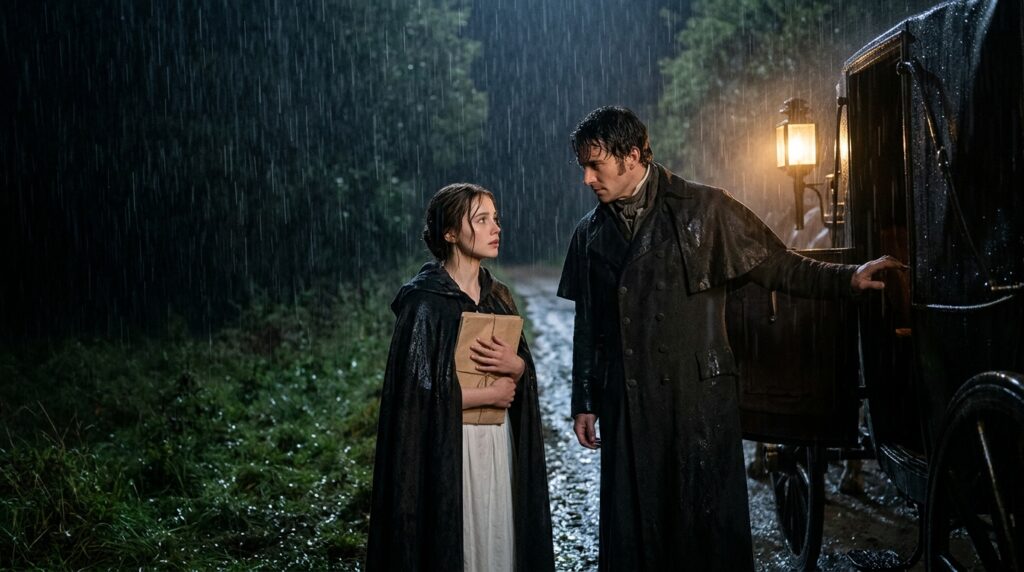
They carried her boxes out one at a time so that it would take longer. That was the part she understood first. She was standing on the gravel at Oborn Court on the 9th of October in the year 1817. The rain came down straight and cold out of a sky that had been white all day. Two boxes, two men.
It could have been done in one journey. It was not done in one journey because a thing done slowly is seen by more people and the windows of the long drawing room faced the sweep and there were nine people at cards behind them. Nobody touched her. That was the second thing she understood. Lady Almyra Oborn stood inside the open door with the light behind her quite dry in gray silk.
She held her elbows the way a woman holds them when she is a little cold and wishes you to know she is bearing it. She did not raise her voice once. She never did. Her voice was low and pleasant and carried beautifully, which is a gift, and she had spent 40 years learning what to do with it.
“Set them down there, Rowan. No, not under the porch. Mrs. Radcliffe will wish to see that everything is hers.”
The first box came down on the wet stone with a small sound, and the second came after it. Then the footman went back for the last of it. He came out with the flat parcel that had been on the table in the schoolroom, tied in green tape. He hesitated because he was 19 and not yet spoiled. Rain was already darkening the paper.
“Ma’am,” he said.
“It’s her music.”
“It is only paper,” said Lady Almyra. “Set it down.”
He set it down. Jennet Radcliffe was 24 years old, and she had learned a great many things in the 2 years since her husband died. She had learned that you must never let them see you go quickly to anything. So, she did not run.
She walked to the parcel. She picked it up and turned it against her body under her cloak, and she stood with the rain going down the back of her neck into her collar. Then she looked at the woman in the doorway.
“My quarter is due on the 14th,” she said.
“You were engaged from the 14th,” Lady Almyra agreed. “And you leave us on the 9th. I could not in conscience pay you for days you have not given. You would not wish me to be careless with what is not mine.”
“No, my lady.”
“I have written you a character.”
A folded paper came out from under the gray silk sleeve held out into the rain so that she must come up the steps for it and be seen coming up the steps for it.
“I have said that you are honest. I believe you are honest. I have said that you play remarkably. That is nothing but the truth. I could not say that you are discreet.”











