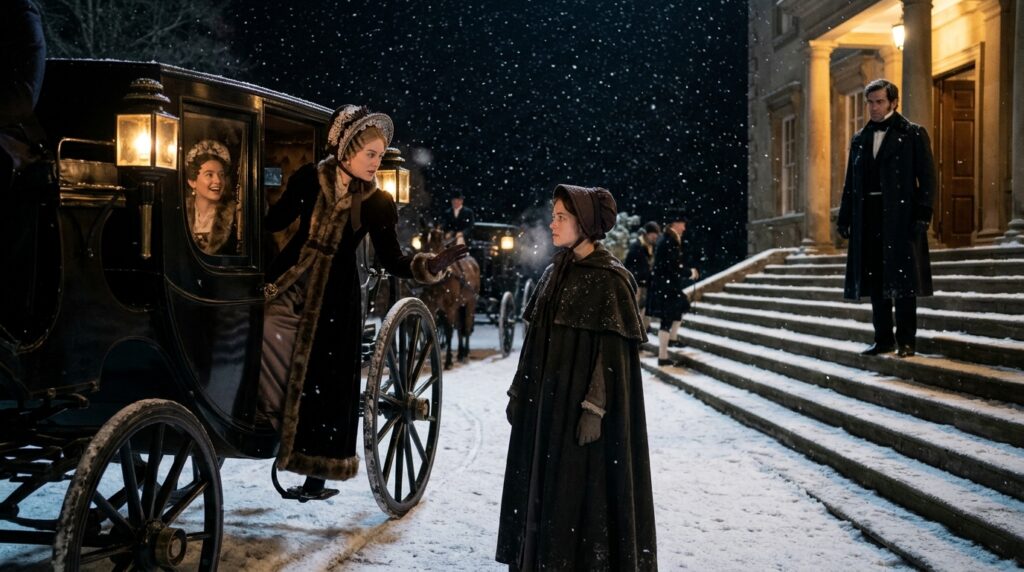
The snow had been falling since supper, and by the time the last dance ended at Ilchester Park, it lay a hand deep upon the steps. Carriages came round one after another, their lamps making small yellow rooms in the dark. The Duke of Ilchester stood in the great doorway to see his guests away, as his father had done before him, and the cold did not seem to touch him.
Antonia Dracott waited at the edge of the light in her darned cloak. Beneath it she wore the faded blue wool that had been her mother’s, let out and taken in so many times that the seams told its history. She had danced twice with a vicar and with a boy of 16, and she had been glad of both.
The Digby carriage drew up. Her stepfather had already been handed in and sat with his chin on his chest, having drunk more of the Duke’s claret than was wise. Camilla came down the steps with her sister Sybil behind her, both in white sarsnet, both laughing at something the squire’s son had said.
“Come, Antonia,” Camilla said, and then she stopped with her foot upon the step and looked back.
“Oh, but there is no room for you in the carriage. Sybil’s gown will crush. Papa is quite spread out. You see how it is?”
“It is 3 miles,” Antonia said quietly, “and it is snowing.”
“Then you had better walk briskly,” Sybil said, and the two of them went up into the carriage like a pair of swans, and the door shut, and the horses moved.
The last thing Antonia heard was their laughter, thin and bright, going away down the avenue into the dark. She stood a moment, then she drew her hood forward and turned towards the gates, because there was nothing else to do.
“Miss Dracott.”
The voice was not loud, but it carried. She turned. The Duke had come down the steps without a hat, the snow settling on his dark hair, and on the shoulders of his dark blue coat. He was a tall man of six and thirty, with a face that gave away very little, and the whole county said he had grown weary of being flattered.
“Your Grace,” she said, and curtsied, and felt the wet come through her shoes.
“You will not walk,” he said.
He did not ask. He turned his head and spoke to the footmen behind him.
“My own carriage. Have the bricks heated and wrapped in flannel and put the fur rug in. Tell the coachman the Grange and to take the lower road, for the upper will have drifted.”
“Your Grace, I cannot,” she said. “Your guests are not all gone. You will have need of it.”
“I am at home,” he said. “I have need of nothing. You are my guest, and a guest of mine does not walk three miles through the snow because there was no room.”
He said the last words with a particular dryness, and she understood that he had seen everything. The carriage came round in a quarter of an hour, the crest gilt upon its door, the lamps lit, the horses steaming. The Duke himself handed her in. The bricks were hot through the flannel, and the rug was heavier than any coat she had ever owned.
“Good night, Miss Dracott,” he said. “I shall hope to hear that you took no harm.”
She could not answer him, and the door closed, and the carriage moved. Behind her, the great house blazed with light, and the Duke stood on his steps in the snow and watched it go. She did not know that she had just been seen clearly for the first time in 9 years. She did not know that by Twelfth Night, the whole county would know it, too.
Antonia’s father had been a curate who died when she was six, leaving nothing but a shelf of books and a widow with a gentle face. When Antonia was 12, her mother married Mr. Digby of the Grange, a widower with two small daughters, a good name, and a very little money. He was not unkind. He was simply never present when unkindness was being done.











