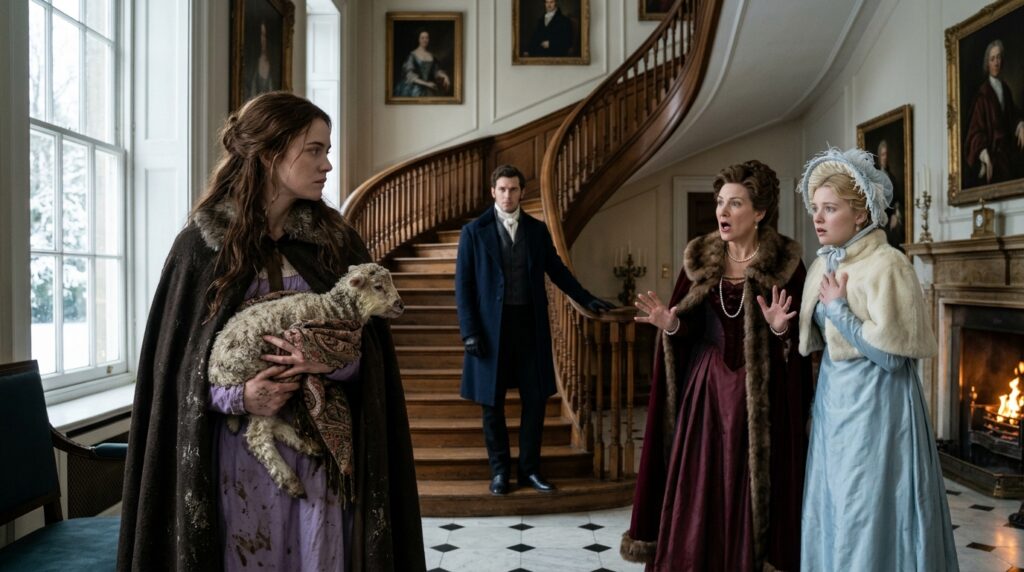
On the fourth day, the rain stopped, and the Wigmore shepherd, a quiet man called Prosser, came down from the lower fold with his arm in a sling. He had broken it on a stile, and he had 200 ewes lambing on the lower pastures by the river, and nobody but a boy of 12 to help him.
“I’ll go,” said Hester at once.
“You will certainly not,” said Lady Harriet, who was crossing the hall. “You are a guest in this house, Miss Kennesley, and a gentlewoman, whatever your stepmother has let you become. What would the county say?”
“The county would say the lambs lived,” said Hester.
The Duke had come out of the library at the sound of their voices. He looked at his aunt and at Prosser’s sling and at Hester, who had already untied her bonnet strings.
“I’ll go with her,” he said. “That will make it respectable.”
“It will make it a scandal,” said Lady Harriet.
“Then it will make it a respectable scandal,” said the Duke, “which is the best kind.”
And he went out bare-headed without a coat into the April evening.
The lower fold at Wigmore stood in a field above the river, a long low shed of stone with a roof of stone tiles and a row of pens made of woven hazel hurdles. And in the lambing season it was never quiet. There was the sound of the ewes calling and the high thin answering cries of the lambs and the river talking to itself below in the dark. A lantern hung from a hook in the roof beam. They worked through that night and the next.
Hester showed him how to tell when a ewe was in trouble and how to turn a lamb that was coming wrong and how to rub a weak one hard with a twist of straw until it shook its head and sneezed. He learned quickly. He had big, careful hands, and he was not afraid of getting them dirty. And somewhere around midnight on the second night, she realized that he had not once touched the button in his pocket since they came into the fold.
At 2:00, the frost came down, the sharp, clear frost of April, and Hester’s fingers went white and stiff. She was trying to tie a knot in a length of twine to hold a hurdle, and she could not do it. Her fingers would not obey her. She laughed at herself and blew on them.
The Duke took her hands in his. He did it without a word, as though it were the most ordinary thing in the world, and folded both her hands between his own and held them. His hands were warm. They were astonishingly warm, warm right through, as though he carried a fire somewhere inside him.
Hester stood quite still. She was aware of her own heartbeat and of the lantern light on his face and of a feeling she did not have a name for at first and then did. It was happiness. It was so unfamiliar that it frightened her and she did not pull her hands away.
“How are you so warm?” she said. “You never wear a coat.”
“I am never cold,” he said. “It’s the one advantage of a bad temper.”
“You haven’t got a bad temper.”
“You haven’t seen it.”
“I have lived with my stepmother for 17 years, Your Grace. I know a bad temper when I see one. Yours is only sad.”
He looked down at her hands in his. And he did not let them go. And after a while, he said,
“Will you call me Gideon here at least? Nobody has called me Gideon since my father died. Nobody but my father for a long time before that.”
“Gideon,” she said.
They sat down on a bale of straw by the lantern, and the lambs grumbled in the pens, and at last, because it was the middle of the night and the darkest hour, and there was nobody to hear but the sheep, he told her.
“I was 10,” he said. “Thomas was 15. It was the 9th of March, 1799. There had been snow all week, very late, and the shepherds were frantic. My father and I quarreled at dinner. I don’t even remember what about. Something stupid. I think I had lamed his hunter. He said I was a disgrace to the name and I threw down my napkin and ran out of the house. I went to the stables first and then I went up the ridge because Thomas always went up the ridge when he was unhappy and I thought it was what you did.”











