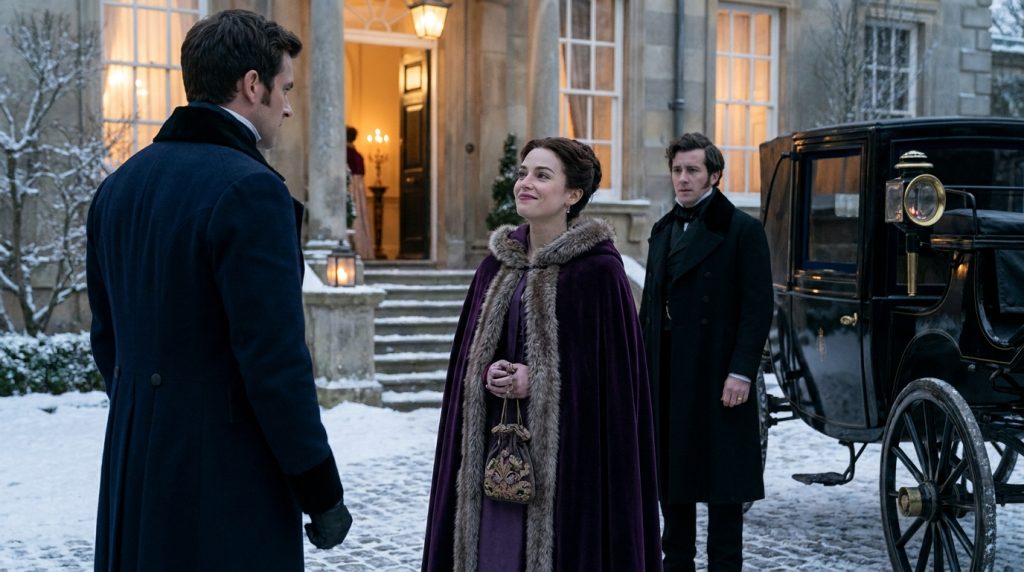
My Wife Said, “It Is Only a Gown. Pray, Do Not Make a Scene”—I Nodded, Packed a Valise, and Left Before Midnight
“It is only a gown, Holden. Pray, do not make a scene.”
My wife stood in the entrance hall of our Chelsea house in emerald silk I had never seen before, with gold earrings I certainly had not given her. It was a Thursday evening. She claimed she was attending a reception for the patrons of a new subscription society. I answered her with one sentence.
“If you leave this house dressed for him tonight, do not trouble yourself to return.”
And Bianca smiled. Not as a woman smiles when she has been wounded. She smiled like an actress who had at last heard her cue. That smile was why I nodded, packed a valise, and was gone before midnight.
For there was something else I noticed in that hall: the little folded paper protruding from her open reticule, covered in her own handwriting. At the top, underlined twice, were the words she had just spoken. Beneath them stood a direction meant for herself: Make him repeat that I may not return. She had prepared this conversation before I ever crossed the threshold.
The papers she sent to be copied afterwards—the papers she believed would help her secure my grandmother’s house—were the reason I kept it.
My name is Lord Holden Ashford. I am six-and-thirty, a younger son with a courtesy title and an occupation my elder brother has never considered quite suitable. I earn my living preparing accurate reports of proceedings in the Westminster courts. I learned shorthand when I was young enough to believe that remembering what men actually said might be more useful than remembering what they wished they had said.
For eleven years, I had sat quietly with my pen while witnesses, counsel, magistrates, and judges spoke. I preserved their hesitations as faithfully as their declarations. Honest people lost their place. They corrected themselves. A rehearsed witness often spoke with a smoothness no ordinary memory could manage.
Keep that in mind. It mattered more than anything else in this affair.
Bianca and I had been married seven years. Our home was a small brick house near Chelsea, with an uneven step and a lilac my grandmother June had planted when I was a child. She had left the house to me outright, outside the family entail. It was not the great Ashford seat, and I had never wanted it to be.
I had paid for its roof from my own earnings. Every substantial repair had an invoice, and every invoice remained in a folder in my desk. My grandmother had taught me that paper was the only servant who could be trusted not to improve a story in the telling.
There was another arrangement, so ordinary that I had nearly forgotten it.
Years before, Bianca had complained that copying her correspondence tired her hand and that she could never find anything once it had been dispatched. I engaged a copying service for the household. For nine shillings and ninepence a month, a discreet woman named Mrs. Bell made fair copies of letters and kept duplicates of whatever papers we sent to her marked for preservation.











