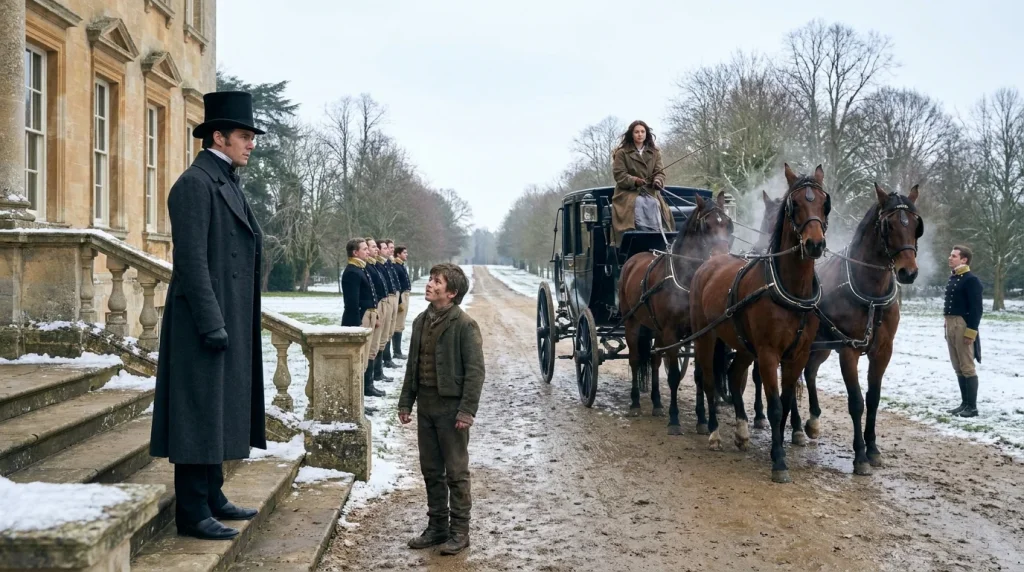
The stable lad came over the park wall at a run without his hat, and he was shouting before anybody at the house could make out a word of it. The wind took most of what he said and threw it back across the grass. It was the second week of March in the year 1817, and it had been blowing for 3 days. The great beeches along the avenue at Iron Park leaned all the same way, like people listening at a door. The whole household had been standing in the forecourt since noon.
Two long lines of footmen and maids with their aprons flattened against their legs. At the top of the steps, by himself, stood Arthur, Duke of Colwick, who had sent his own carriage for his bride, and been told to expect her at 1:00. It was now past 3. He had not gone in, and not a soul had dared to suggest it. He was 31, tall and spare in a dark coat, with auburn hair the wind was making free with and moss green eyes that had not once left the gates.
Mrs. Oaks, the housekeeper, had known him since before he could walk, and she noticed what the others did not. He was standing on the left hand side of the top step, very straight, very still, and as the hour went by, he had grown slowly paler. She looked away from it, as she would have looked away from a man undressing. She knew what that step was, and there were not many left at Iron Park who did. The lad reached the foot of the stairs and folded over with his hands on his knees, fighting for the breath to speak.
“The carriage, Your Grace,” he got out. “It’s on the hill.”
The Duke looked down at him.
“You left it?”
The voice was quiet, and it stopped the lad’s breath better than a shout.
“She sent me, Your Grace, over the wall on foot. It saves the long way round to get the surgeon fetched. Mr. Bray’s inside it, laid along the seat, and he can’t speak. He went over on the box.”
Arthur came down a single step, the first time he had moved in 3 hours.
“Then who is driving my horses?”
The lad straightened up and looked at him with a kind of terror, and also though he could not have said why, with a kind of joy.
“The lady,” he said. “It’s the lady that’s driving.”
The two lines did not stir. Then the gates, a long way off, showed something dark between them, and it began to come up the avenue under the leaning trees. It came at a steady trot, and that was the first thing Arthur noticed. He had been ready for a runaway, or a crawl.
A frightened driver saws at a horse’s mouth, and the horse tells you so from half a mile away. These four bays were coming up on a level, collected, with their heads where they ought to be. They were mud to the shoulder, and the carriage was mud to the windows. On the box, in old Bray’s great caped coat, with the sleeves turned back, sat a small, straightbacked figure with no bonnet at all, and dark hair coming down on one side.
She brought the team round the sweep in a long, clean curve, without hurry. She stopped them with the carriage door exactly at the foot of the stairs, which was where Bray himself would have stopped them, and where no other driver had ever managed it. She wound the reins around the rail and then she looked up and he saw a young woman white with cold with hazel eyes and a streak of mud along her jaw.











