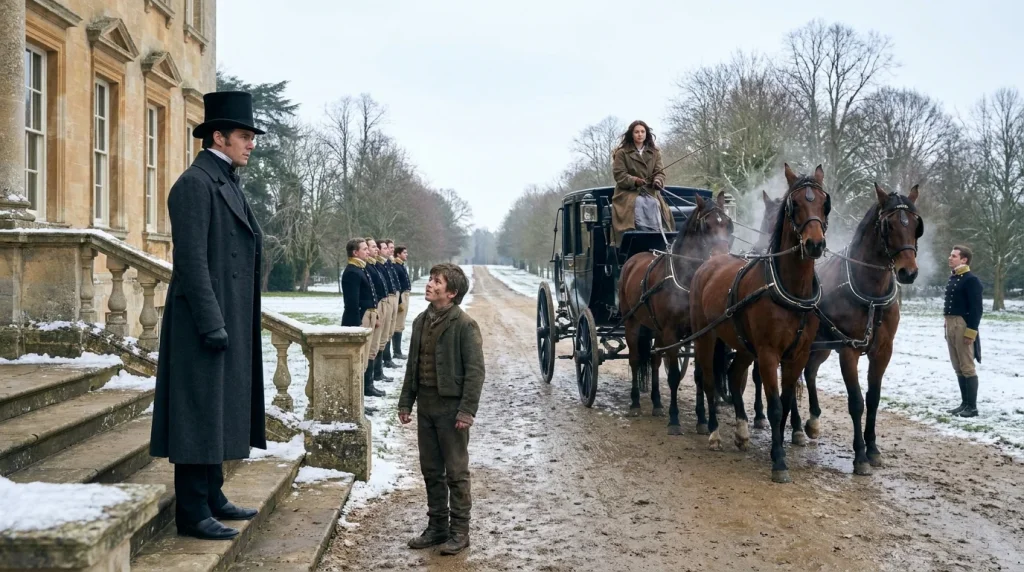
“Is the surgeon coming?” she said.
She did not say Your Grace. She did not say anything else at all.
“He is sent for,” said Arthur, and he was already past her with his hand on the door.
Bray lay along the seat under the carriage rug, packed in with cushions. Somebody had tied him there with a lady’s shawl, knotted twice, so that the sway of the road would not throw him to the floor. He was 73 years old, and he had put the first rein Arthur ever held into his hand. One side of his face had slipped, and his eyes were shut. The Duke of Colwick got an arm under the old man’s shoulders and another beneath his knees and lifted him out himself, and two footmen who had started forward stopped where they were.
In all the years they had served him, they had never seen him hurry. He carried his coachman up the steps like a child, and he weighed scarcely more than a child, and it was only at the top that Arthur turned his head. She had got down by herself, since no hand had been offered. She was standing with one hand on the wheel, and he understood later that it was holding her up, though she made it look as if she were examining the wheel.
“Miss Renworth,” he said. It was not quite a question. She took her hand away from the wheel in a coachman’s coat in the mud in front of 40 servants. She made him a correct and unhurried curtsy.
“Your Grace,” she said. “I am sorry to be late. We came by the Reading road, and I did not know your hill.”
Something moved at the corner of his mouth and was gone. He went in with Bray in his arms, and Mrs. Oaks came down the steps with her face, working to take charge of the bride. None of them noticed that the bride’s right hand had gone back into the pocket of the great coat. It had closed around something there, very hard, and it stayed closed. She came with the meadows.
That was how they put it in Henley, and they did not put it unkindly. Iron Park sat on its hill with all its farms behind it. And between the hill and the Thames lay a long green mile of water meadow and a wharf called Loa’s Hythe. No wagon of Iron Park corn had ever reached a barge without crossing Renworth grass and paying for the privilege. For three generations the Colwicks had paid and looked down from their hill at the barges and never once called.
Then the old duke died and his son came home from the embassy at Vienna to find his farmers going under. He sent word that he would buy, and word came back that the land was not for sale, but that there was a daughter. The rest was done in an afternoon in a back room at Reading by two men of business, and neither of the people who would have to live with it was present. The meadows would pass to Iron Park on the day she married. She would go with them, the way a gate goes with a field.
Juliet Renworth was 23, and she had been the second thing in every room of her life. Her mother had died before she could remember her. Her father had married again when she was three, and the lady he married was Cresa, granddaughter of an earl who had come down in the world and taken a wharf master to keep a roof over her head. Cresa had spent 20 years making the county forget the second half of that sentence. Her own daughter Charlotte was 19 and truly lovely and Juliet was the one who met the barges.











