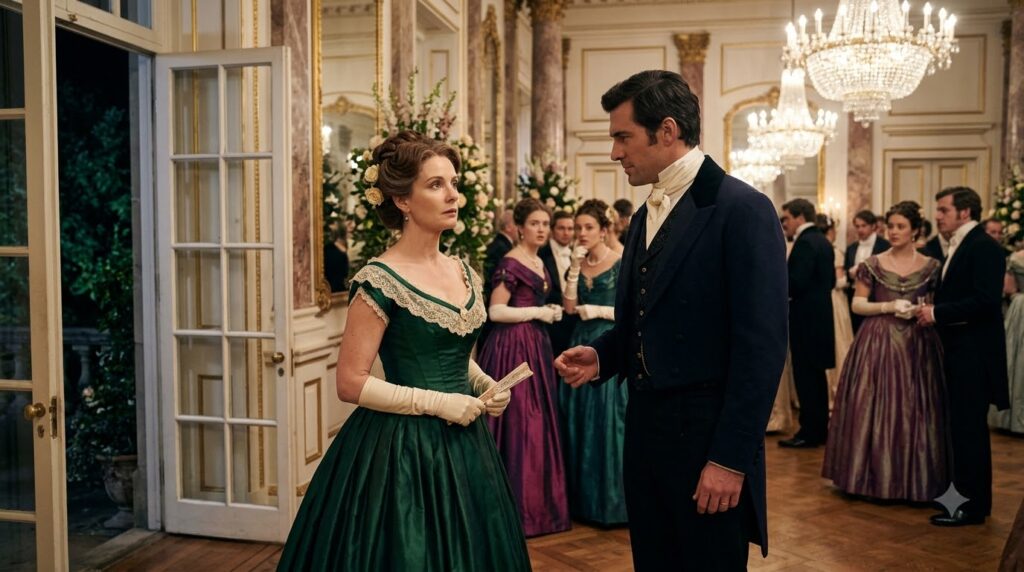
London, May 1851.
Rain tapped softly against the windows of Whitmore House as Lady Eleanor Whitmore sat in her favorite armchair, an embroidery hoop forgotten in her lap. At thirty-seven years of age, with chestnut hair now touched with silver at the temples, she had long since accepted the cruel label society had placed upon her: spinster. The grand library of Whitmore House was her sanctuary, with towering mahogany bookshelves, leather-bound volumes, beeswax polish, and the faint scent of lavender tucked between the cushions.
Through the bay window, Eleanor watched raindrops turn the London streets into ribbons of gray and amber. She traced one finger over the delicate rose pattern she had been stitching, a botanical study born from her deepest passion. Unlike many ladies who embroidered merely to seem accomplished, Eleanor truly loved rare plants and careful cultivation. Her private garden behind the house held roses she had nurtured for years, each one a small triumph against time.
At her feet, Wellington, her brother’s aging spaniel, sighed contentedly, his graying muzzle resting on her slipper. Across the room, Byron, a portly ginger cat rescued from starvation two winters earlier, had taken possession of a reading chair and showed no intention of surrendering it. “You are both terribly spoiled,” Eleanor murmured, though neither animal stirred. This was her life now: quiet afternoons, loyal animals, books, gardens, and the peaceful solitude of a household that no longer expected much from her.
Mrs. Davies entered with a silver tea tray and set it beside Eleanor with the gentle familiarity of nearly two decades of service. There was no pity in the housekeeper’s face, only warmth. She asked whether Eleanor would dine with the family that evening or have a tray sent to her rooms. Eleanor chose to join them, asking whether her brother had returned from Parliament.
Lord James Whitmore had arrived, Mrs. Davies said, and young Thomas was already pestering him about their promised fishing expedition. Eleanor smiled at the thought of her nephew, fourteen years old and full of boundless energy. Her niece Charlotte, sixteen and nearly ready for her first season, was equally precious to her. Motherless since childhood, both children had received from Eleanor all the love she would never give to children of her own.
Then a purposeful knock broke the calm. The library door opened, and James entered, still in his parliamentary attire, carrying an embossed invitation sealed with the Peyton crest. Eleanor recognized it at once, and her stomach tightened. James placed it on the table between them and said quietly, “The Peyton ball. Two weeks hence. We have been invited.”
“How lovely,” Eleanor replied, though she did not touch the envelope. James leaned forward, his expression gentle but firm. As his hostess and Charlotte’s aunt, Eleanor was expected at major social events. Charlotte’s debut season was approaching, and their family could not afford to withdraw from society completely.
Eleanor set down her teacup with careful precision. She had attended a musicale the previous month, but James reminded her that a small musicale was not the same as a Peyton ball. Half of London would be there. “You cannot hide forever, sister,” he said softly.











