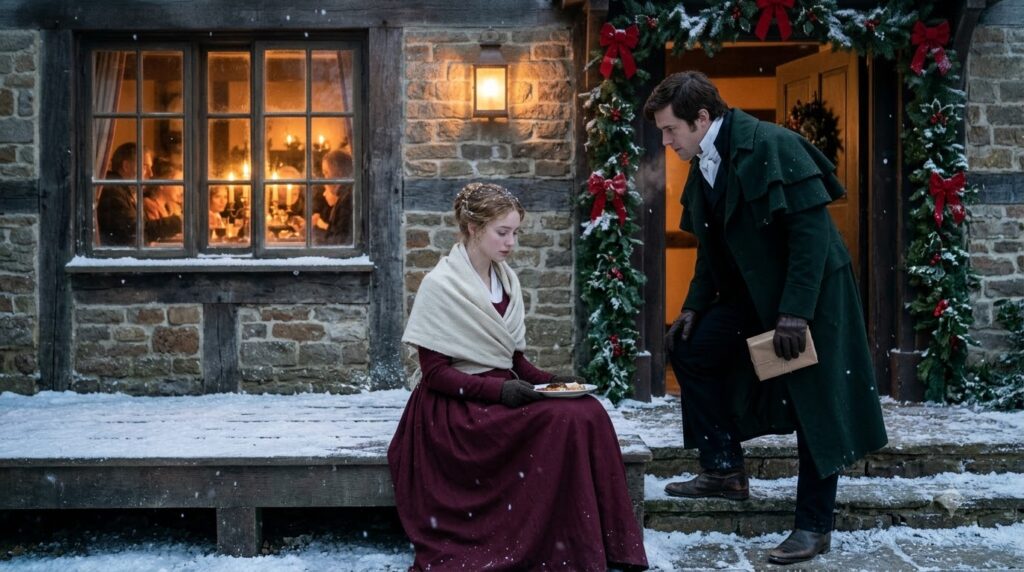
There Was No Room for Hannah at the Christmas Table. The Rancher Chose the Cold Porch Beside Her.
CHAPTER 1: TWO DAYS BEFORE CHRISTMAS
By the morning of December twenty-third, Hannah Mercer had flour in her hair, a burn on the side of one thumb, and a list of work long enough to keep three women busy. She did not complain. Complaining had never changed much in the Mercer house.
The ranch house stood low and square against the winter land, built from weathered pine and stone gathered from the creek. Beyond it stretched miles of pale grass, sleeping under patches of snow. Cottonwood branches clicked in the wind. Cattle moved slowly near the eastern fence, dark shapes against the white.
Inside, the kitchen was warm. Hannah pushed both sleeves above her elbows and leaned over a wooden bowl, kneading bread dough with strong, steady hands. Her younger half brother, Samuel, appeared in the doorway.
“Can I have some?”
Hannah did not look up.
“Some what?”
“Whatever smells good.”
“That would include nearly everything in this kitchen.”
Samuel grinned. At thirteen, he was all elbows, brown hair, and hungry eyes. He had his father’s smile, which was one of the reasons Hannah found it difficult to stay angry with him. He stepped closer to the table.
“What’s that?”
“Bread.”
“What’s in the pot?”
“Apples.”
“And the other pot?”
“Don’t touch it.”
His hand stopped halfway.
“I wasn’t going to.”
“You were thinking about it.”
Samuel shoved both hands into his pockets.
“Christmas is supposed to be about sharing.”
Hannah finally glanced at him.
“Then share the wood chopping with me.”
His grin disappeared. She laughed softly.
“Go on. There’s cold coming tonight.”
Samuel groaned, but he obeyed. For several minutes Hannah was alone with the sound of the fire, the wind at the windows, and the steady rhythm of her hands pressing dough. She liked moments like that. They were simple. Bread did not pretend not to hear her.
A pie did not look through her as though she were part of the furniture. A kettle did not remember that Hannah had been born to another woman. Work could be hard, but it was honest. People were more complicated.
Her father, Robert Mercer, had remarried when Hannah was twelve. Her own mother had been gone nearly four years by then, taken by a fever that had moved through the valley one summer and left behind empty chairs in nearly every church pew. Hannah still remembered her mother’s hands.
Soft when they rested on Hannah’s forehead. Rough when they worked. Her mother had taught her that both things could be true at the same time.
“A good heart doesn’t have to be a weak one,” she had once told Hannah while mending a torn shirt.
“Remember that when you grow older.”
Hannah had remembered. She had not always known how to live by it.
Her stepmother, Margaret, entered the kitchen without knocking because no one knocked inside their own house. She wore a dark green wool dress, practical and well kept, and carried a folded tablecloth over one arm.











