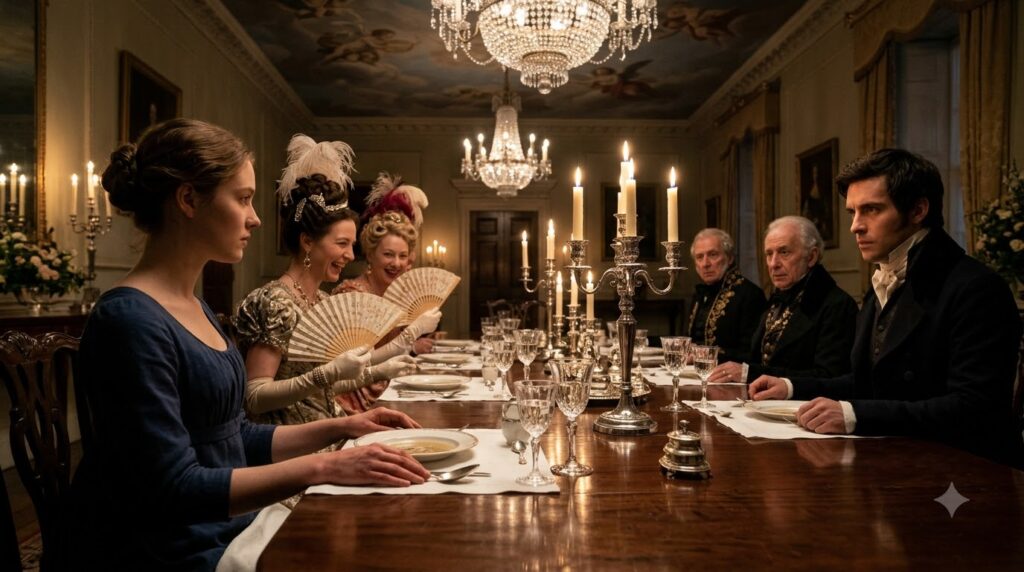
“She cannot understand us,” Lady Honoria Blake said in Italian, and she laughed behind her fan.
The two ladies beside her laughed, too. They were sitting at the long dinner table at Cadbrook Hall under 20 candles in a ceiling painted with angels. Across from them sat the new Duchess of Cadbrook, a quiet young woman in a plain blue gown. Her name was Tess. She had been married for 3 weeks.
“Look at her hands,” said Mrs. Fanny Lyle, Lady Honoria’s sister, still in Italian. “Red as a kitchen maid’s. The Duke found her in some little shop, I am sure of it.”
“He found her in the gutter,” said Lady Honoria. “And now she sits at the head of his table, smiling like a doll, and she has no idea that we are talking about her. Poor thing. She does not know one word.”
They laughed again. At the far end of the table, an old Italian gentleman, Count Rinaldi, frowned into his soup. His wife, the Contessa, looked down at her plate. They were the guests of honor that night, and the English ladies had begun speaking Italian to please them.
But it was not pleasing them at all. Tess put down her spoon. She looked straight at Lady Honoria, and she spoke in Italian. Her voice was soft and clear, and every word was perfect, as if she had been born in Florence.
“My hands are red because I have worked, Lady Honoria. I am not ashamed of that. But a tongue that is cruel in two languages is twice as cruel, and I understood every word.”
The table went silent. Lady Honoria’s fan stopped moving. Mrs. Lyle’s face turned the color of the wine. The third lady, young Miss Caroline Thorpe, put her hand over her mouth. Then the Contessa began to laugh. She clapped her hands together.
“Brava!” she cried. “Brava, Duchess. Where did you learn to speak like that? You speak like a lady of my own city.”
Tess smiled at her and answered in Italian.
“I lived in Florence for 7 years, Contessa. I was a companion to an old English widow, Mrs. Whitlow. She was nearly blind, so I read to her every day in Italian because she loved Italian books. And I did her shopping in the market on the Via dei Neri.”
“The Via dei Neri,” said the Count, his whole face lighting up. “I was born on that street.”
At the head of the table, Leon, Duke of Cadbrook, leaned back in his chair. He was a tall man with dark hair and dark, serious eyes. His Italian was not very good, but it was good enough. He had understood what the ladies said, and he had understood his wife’s answer. He looked at Lady Honoria for a long moment. Then he looked at Tess, and his serious eyes became warm.
“Well done, my love,” he said quietly in English.
After dinner, the Count and Contessa would not leave Tess’s side. They talked of Florence, of its bridges and its bells, of the old woman who sold flowers by the church. The Contessa held Tess’s hand and called her cara, which means dear. Lady Honoria stood by the fire and watched them. Her face was pale and still. Later, when the house was quiet, Leon found Tess on the stairs.











