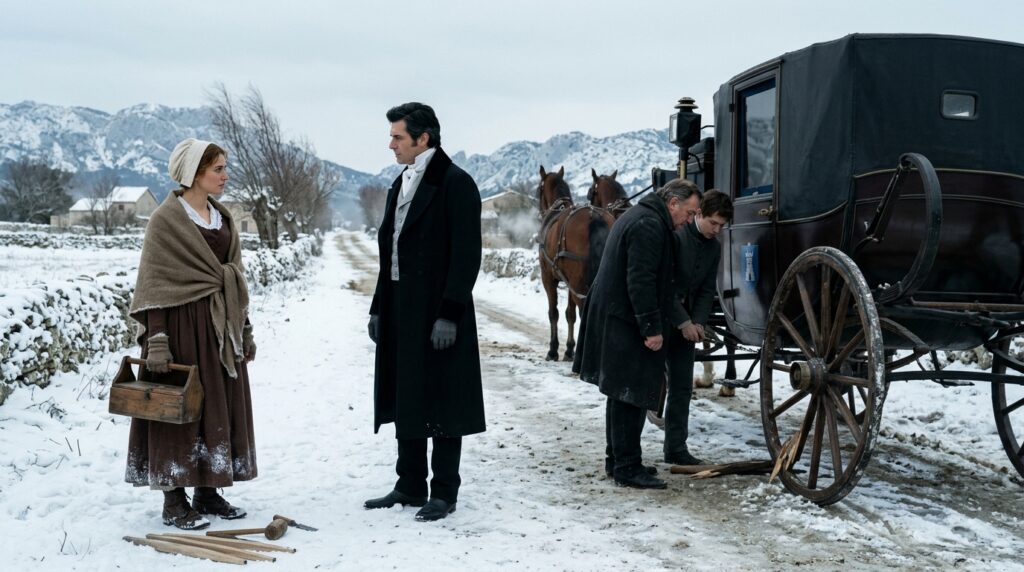
In Provence in 1838, in a village where everyone knew each other by name and by their sins, there was a young woman whom no one looked in the eye. They looked at her hands, hands covered in scars marked by the fire on a night when she tried alone to pull her father from the flames. The whole village called her the girl with the burned hands and whispered that no decent woman worked in a workshop like a man. No one knew that those hands were proof of the greatest love Saint-Rémy had ever seen. No one knew either that behind the door of that workshop, a stepmother was stealing her work, her name, and even her father’s inheritance.
Until one stormy afternoon, the carriage of the coldest duke in Provence broke a wheel at the entrance to the village. The man who never took off his gloves for anything in this world and who treated marriage as a contract found himself before a young woman kneeling in the mud, who refused his gold with a single sentence. At that moment, something dormant for eight years awoke within him. This is a story about the value of honest work, about the marks that pain leaves on the body, and about the kind of love that is only born when someone sees what the world prefers to hide.
Provence, autumn of 1838.
The mistral descended from the north as it has for centuries, without asking permission. It swept across the already harvested lavender fields, where only the grey stalks remained, close to the ground, awaiting the next spring. It bent the rows of trees lined up by the roadsides, made the wooden shutters of the light stone houses groan, and dragged heavy, leaden clouds across the sky, which seemed ready to break at any moment. The air smelled of damp earth, the smoke of olive wood, and the sweet, tired residue of the last grapes crushed in the wine presses. The small village of Saint-Rémy rested at the foot of the Alpilles, those low mountains as pale as ancient bones.
It was a village of narrow streets, moss-covered fountains, and enormous plane trees that shed golden leaves over the square. France at that time was still trying to recover from decades of revolution, wars, and empires. The old nobility had returned from exile, reopened their castles, and reclaimed their titles. And the people, the real people, those who had never stopped working the land, continued doing what they had always done: planting, harvesting, repairing, surviving. And at the end of the coopers’ street, where the houses gave way to the first dry stone walls, stood the Fournier workshop.
For 30 years, that had been the most respected place in the region for anyone who owned a cart, a stagecoach, or a carriage. Antoine Fournier, the wheelwright, was known from Arles to Avignon. They said that a wheel made by him could last two generations. They said he knew wood like a priest knows the scriptures. He knew which way the oak would split, how much the ash could bend, in what season the timber should be cut.











