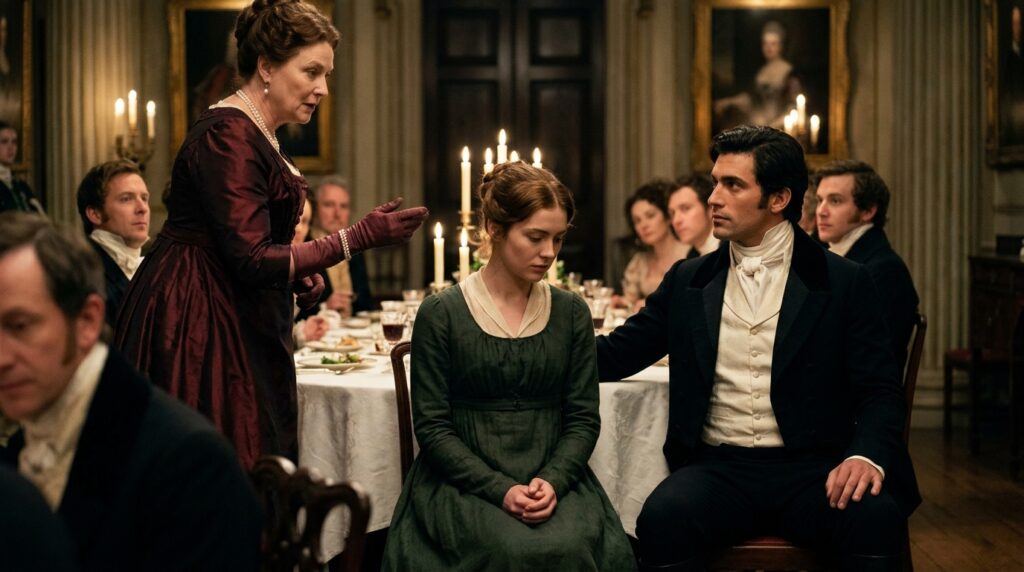
They went up. Thurza followed with the jar. She set it on the table in the small drawing room where the fire had been lit for 2 hours and still had not conquered the cold. She was turning to go when Lady Cecily spoke.
“Wait, say something else.”
Thurza stopped. Lady Cecily was 30 and handsome and had been brought down from town by the dowager for a purpose that everybody in the house understood by the second morning. She had a low, pleasant voice. She used it the way other people use a lamp to show you a thing she wanted you to look at.
“You said the heather cut was stronger,” she said. “Stronger than what?”
“Than the clover, my lady, and the lime.”
“And which do you prefer?”
“For a throat, the heather, it is more…”
Thurza heard herself go towards the word and could not stop in time.
“It is more efficacious.”
4 seconds of silence. Then Lady Cecily laughed, and one of the gentlemen laughed after her. The sound came out into the passage where Thurza had already got the door shut behind her. She heard it through 2 in of oak.
That was the way she heard most things at Holmfall. She went down the back stairs steadily, one hand on the rail. Behind the door, the dowager was saying:
“You see, six years I have heard of this girl. Mrs. Grindle calls her the cleverest thing in the county.”
“Where does she get them?” said Lady Cecily.
“The words? Books, apparently. Nobody has ever spoken to her in her life.”
“Then somebody ought to,” said Lady Cecily, “at length at dinner in company.”
There was more laughter and then a lull. Then the dowager’s voice again lower. It had in it the particular carefulness of a woman making a decision she intends to call a joke.
“Thursday,” she said, “we are 13 at table on Thursday. Sir Wilmont will not sit down 13.”
“You would not.”
“It is a kindness,” the dowager said, “she shall have a good dinner, and you shall all be very civil to her, and we shall see what six years of Mrs. Grindle’s cleverest thing in the county sounds like between the soup and the sweet.”
The word came down at 8 the next morning by Mrs. Grindle, who delivered it, standing very straight, with her hands at her sides.
“Her Grace desires you to dine at her table on Thursday. You are to be there at 6. You will be sat down with the company.”
The kitchen went quiet in a way Thurza had not heard before.
“Why?” Thurza said.
“That is not a question you may ask.”
“I am asking it in your kitchen, ma’am, not in her drawing room.”
Mrs. Grindle’s mouth thinned. For a moment something went over her face that was not contempt and Thurza who had watched that face for 9 years could not put a name to it.
“They are 13,” the housekeeper said. “Wilmont Chettle will not sit down 13. That is the reason you will be given if you ask above stairs.”
“And the other reason?”
“You have a good gown?”
“I have my mother’s.”
“Then wear your mother’s,” said Mrs. Grindle and went out.
And it was only when the door had shut that Mrs. Mabley said into the pastry.
“She might have said no for you. She said no for girls before.”
Thurza took the long way to the stillroom past the yard and did not stop at the hives. She went instead down the field path to the cottage at the end of the walled garden where Avis Tenniswood lived on £8 a year and a load of coals and had lived since her eyes went. Avis had been lady’s maid to the Duchess of Carsley for 28 years back when the Duke was alive and Holmfall lit 400 candles at Christmas. She was 76. She could still thread a needle by feel, and she gave her opinions without any softening at all.











