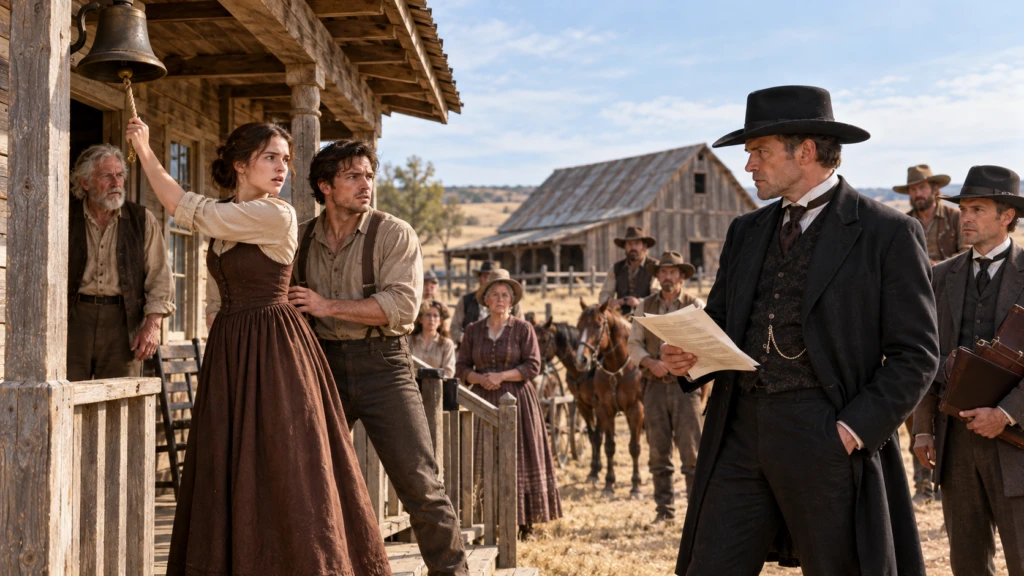
A Land Agent Came to Take Their Farm: Then the Young Woman Rang the Bell
The first wagon arrived just after noon, when the heat had flattened the fields and everyone on the Mercer farm was trying to finish work before the sky turned mean. Caleb Mercer saw the black coat before he saw the papers. The stranger stepped down clean-shaven, polished, and completely wrong for a place where dust settled on everything before breakfast. Behind him stood a county clerk with a leather case. Caleb’s father, Amos, met them at the gate with a shovel still in his hand.
The visitor introduced himself as Edwin Hale, representative for the Prairie Land and Trust Company. He did not remove his hat. He said the Mercer note had matured, the payment had not been received, and possession of the property would transfer before sunset unless the family vacated voluntarily. Amos stared at him as if he had spoken another language. The payment had been delivered six days earlier.
Caleb had watched his father seal the envelope and hand it to the stage driver himself. Hale unfolded a document and tapped a line with one gloved finger. No payment appeared on the company’s books. Therefore, in his words, there was nothing left to discuss. Mara Mercer stood on the porch beside Caleb, one hand pressed to her apron.
She had been quiet since the strangers arrived, but her eyes kept moving from the papers to the brass bell hanging above the porch rail. That bell had been used for fires, births, storms, and once when a child disappeared near the river. Hale told Amos to put down the shovel and accept what was lawful. Amos answered that law should begin with the truth. Hale smiled without warmth.
Then he pointed toward the house and told the clerk to begin an inventory. Caleb stepped down from the porch. Mara caught his sleeve. She did not look frightened anymore.
She looked decided. Before anyone could stop her, she reached for the bell rope. Nobody standing there knew the whole truth yet, which was exactly why slowing the process mattered more than winning an argument on the spot. In later years the family would remember that uncertainty more clearly than any speech, because uncertainty was what made every small decision feel consequential.
People often imagine courage as certainty, but those who were present remembered mostly doubt, embarrassment, and the stubborn decision to keep asking for one more fact. The road, the porch, and the fields looked ordinary throughout it all, which made the threat feel more real rather than less dramatic. Every document carried a human consequence, and every delay gave someone another chance to compare what had been written with what had actually happened. That was why the moment mattered.
The bell’s first strike rolled across the valley harder than Caleb expected. It was not a church bell, only an old bronze farm bell mounted under a cedar beam, but sound traveled strangely over open land. The second strike carried beyond the Mercer fence. By the third, Amos stopped arguing. Hale turned toward the porch with irritation.
Mara pulled again. Caleb understood what she was doing before the visitors did. Fifteen years earlier, after a prairie fire burned three barns in one afternoon, the families along Cottonwood Road had agreed that the Mercer bell would serve as a warning. Three slow rings meant fire. Five quick rings meant injury.
A steady, repeated toll meant trouble that required witnesses. It had not been used that way in years. Hale ordered Mara to stop. She ignored him.
The county clerk looked uncomfortable and whispered that perhaps they should wait. Hale snapped that the order was valid whether ten people watched or a hundred. Mara finally released the rope. Silence returned for several seconds, then came the faint sound of a horse at speed.
Another answered from the south road. Dust appeared beyond the wheat. Caleb looked at Hale and saw the first crack in the man’s confidence. The land agent gathered his papers and said witnesses would not alter a debt.











