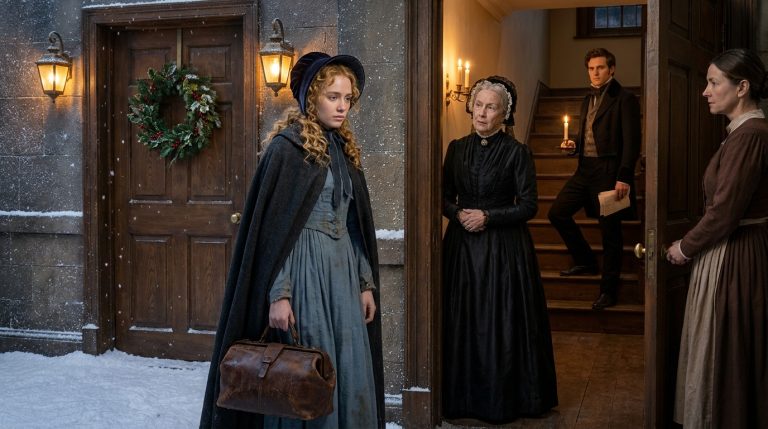
Genevieve arrived on a Tuesday with four trunks of silk, two loudly barking hunting dogs, and laughter as bright as crystal. She was young and dazzlingly beautiful, with golden hair and a charming pout that had once made Alistair feel like a conquering hero.
“Oh, Alistair, it is practically a fortress!” she exclaimed, spinning through the great hall with her velvet cloak swirling around her. She surveyed the dark wood paneling and the towering portraits of his ancestors, then shuddered. “We must change the curtains. And this lighting is terribly gloomy. We need brighter colors, something French.”
“Of course, my dear,” Alistair said, handing his coat to Carson. The butler accepted it with a face carved from granite. He neither looked at Genevieve nor welcomed her. “Shall I have tea sent to the blue drawing room, Your Grace?” Carson asked, staring at a point on the wall just beyond Alistair’s left ear.
“Yes, and see that Miss Rousseau’s luggage is taken care of.”
Genevieve linked her arm through his, pressing close with an affectionate warmth. This was what he had longed for over so many years: spontaneity, tenderness, a woman who looked at him with admiration rather than scrutiny. But as the days went by, the painful reality of Beatrice’s absence began to sink into the very foundations of the house.
Rothbury House had always run as smoothly as a Swiss watch. Fires were lit in the principal rooms precisely ten minutes before Alistair entered. The cook knew to prepare lighter dishes when he was under strain and rich, hearty meats after a day of riding. The silver gleamed, the table linens lay perfectly flat, and the invisible machinery of the estate operated quietly without Alistair ever having to give an order. Now, piece by piece, it was grinding to a halt.
One afternoon Genevieve tried pouring his tea in the drawing room. She chattered about a ribbon she had seen in a dressmaker’s window while casually dropping two lumps of sugar into his porcelain cup.
Then she flooded it with cream and slid the cup toward him with a radiant smile. Alistair stared at it. The tea was pale and sweet. For nine years his tea had appeared on his desk precisely at three o’clock, black and scalding, with a razor-thin slice of lemon resting on the saucer. He took a sip of the sugary mixture and felt his stomach turn. “Thank you,” he muttered, struggling to swallow.
Genevieve did not notice his grimace. She failed to notice that the fire had gone out because she had not thought to call a servant. She was oblivious to the draft rattling the windows, a draft Beatrice had always blocked with heavy dark curtains that Genevieve had gleefully ordered removed. The house was cold. It was always uncomfortably cold.
The servants’ silent rebellion was absolute. They did not refuse orders. They merely became incompetent in ways that no one could quite punish. Meals arrived lukewarm. Alistair’s boots were polished but lacked the brilliant shine he had grown accustomed to. When he asked for a particular document from the estate office, it took hours to locate.
One evening, in a fury, Alistair stormed into the kitchens, where he had not set foot since childhood. The room fell silent. The cook, kitchen maids, and footmen all stopped and stared at him. “Where is the winter coal requisition ledger?” he demanded. “The house is freezing, and the merchant says he has not received his quarterly payment.”
The cook, a stout woman who had worshipped Beatrice, wiped her hands on her apron. “Her Grace always dealt with the coal merchant herself, Your Grace. She knew his wife, you see. She always sent a box of biscuits with the order, so he supplied the very best of his stock. We have no such book here. We thought you had taken charge of it.”