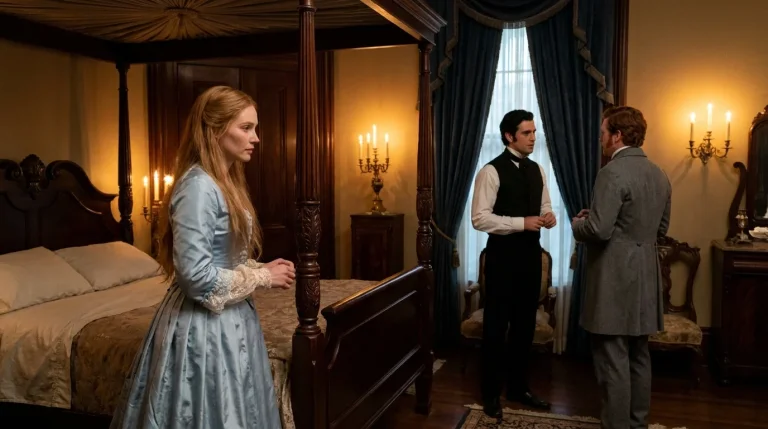
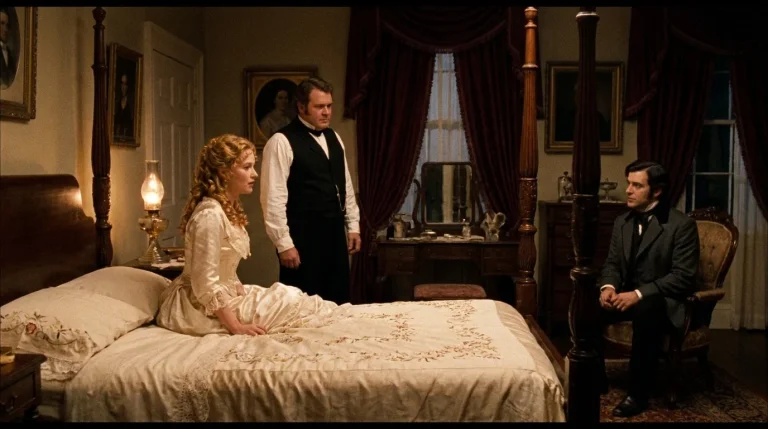
Alistair stepped back, his jaw tight. He returned to the library and ransacked the drawers of his mahogany desk. He found only blank paper and dried-up ink. Then he spotted a small silver key at the back of the bottom drawer. It belonged to a locked cabinet in Beatrice’s private sitting room.
He climbed the stairs, passing Genevieve’s room, where she was loudly complaining to her maid about the hardness of the water. He pushed open Beatrice’s door. The room carried a faint scent of dried lavender and old paper. It was bare of personal possessions except for a tall oak cabinet in the corner. Alistair slipped the key into the lock, and it turned with a heavy click.
Inside were rows of carefully labeled, leather-bound ledgers. He drew one out. Estate Maintenance, 1821 to 1823. He opened it. The handwriting was crisp, elegant, and astonishingly precise.
“October 14. The south wall of the tenant farm requires reinforcing. The stone is weak. Do not trust the surveyor’s original estimate. He drinks before noon. Send Jenkins to supervise.”
“November 2. His Grace’s knee aches in damp weather. Ensure the library fire is laid with applewood. It burns hotter and longer. Do not let him notice anyone making a fuss. He hates to feel old.”
Alistair stopped reading. He stared at the words until the ink blurred. “Do not let him notice anyone making a fuss.” Slowly he lowered the book. He had believed Genevieve was fire and Beatrice was ice. But standing within the cold, decaying shell of his own home, holding tangible proof of a decade of quiet, devoted labor, he understood his terrible mistake.
Genevieve was a spark, blazing brightly but giving no true warmth, disappearing as soon as the wind caught it. Beatrice had been the hearth fire. And he had poured water over it, expecting the house to stay warm.
Two hundred miles away, winds swept in from the English Channel, flinging salty spray against the jagged cliffs of Lyme Regis. Beatrice drew her heavy wool shawl closer around her shoulders and leaned into the gale. The cold air stung her cheeks, but for the first time in nearly ten years she could breathe. There was no soot in the air, no stale tobacco smoke, no suffocating perfume, and no burden of managing a man who refused to be managed.
She lived in a small stone cottage tucked into a hillside overlooking the gray, restless sea. It had two rooms, a crooked chimney, and a little garden at the back where the soil was too salty to grow anything except rosemary and a few stubborn weeds. It was the most beautiful place she had ever seen.
She made her way down the steep, cobbled lane toward the harbor. Fishermen were bringing in their morning catch. She did not send a servant to shop for her.
She had none. Martha had offered to stay and work for nothing, but Beatrice had insisted that the girl take a position with a respectable London family. Beatrice’s reputation was already in ruins. There was no reason to drag an innocent maid down with her.
She stopped at a wooden stall to examine the gleaming silver mackerel laid out on ice. “Good morning, Mrs. Roth,” the fishmonger said, tipping his cap. She had abandoned her title and her husband’s surname. Now she was simply Mrs. Roth, a widow in name if not in fact.
“Good morning, Mr. Evans,” Beatrice answered briskly. She pointed a gloved finger at three fish. “I’ll take those three, and I will not pay more than four pence. They have been lying there since sunrise.”