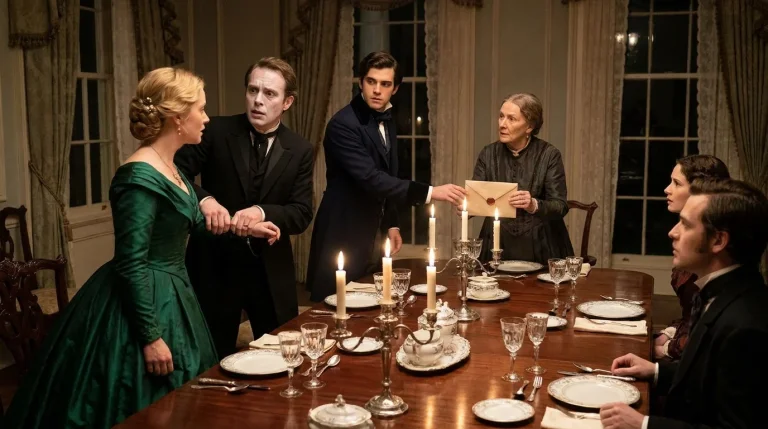
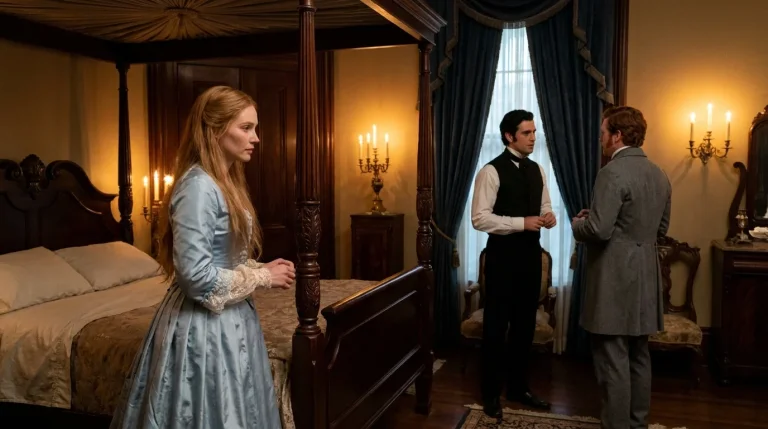
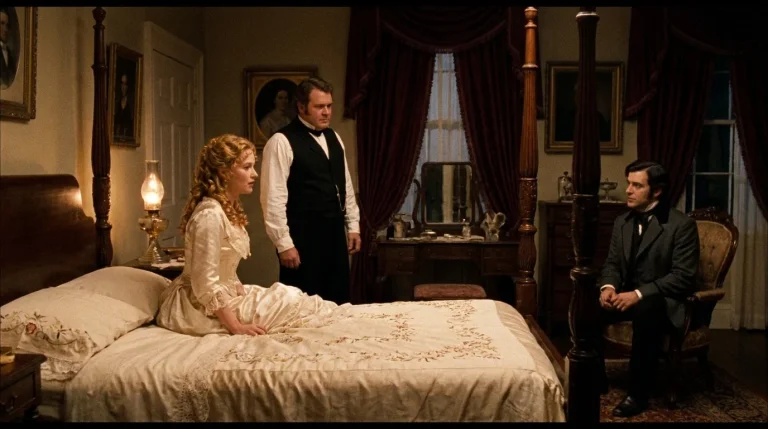
Alistair pulled toward him the heavy notebook he had taken from Beatrice’s sitting room. For three nights he had been trying to decipher her shorthand. She had recorded more than figures; she had recorded financial leverage. One entry, written two years earlier, concerned Coburn’s eldest son, an apprentice blacksmith in Leeds who had fallen deeply into debt. If the estate discreetly paid the young man’s creditors, Coburn would accept a lower price per bushel of spring wheat. The arrangement saved the estate four hundred pounds each year. Her note ended: “Never mention the boy to Mrs. Coburn.”
Alistair stared at the page. It was a masterpiece of manipulation disguised as aristocratic benevolence. Beatrice had managed farmers, merchants, and tradesmen across the county, keeping them loyal, employed, and profitable for Rothbury, all while smiling politely over her tea.
He reached for his Scotch but struck a stack of unpaid bills instead. The papers scattered across the floor: invoices for Genevieve’s gowns, for imported French wines she demanded, and from the butcher who had abruptly refused the household further credit. Alistair knelt on the Persian rug and began gathering them with shaking hands.
He was thirty-four, a nobleman who had once believed himself invincible. He looked at a silk merchant’s bill for five hundred pounds and remembered Beatrice standing in this room, calmly pointing out that he had spent three thousand pounds on another woman. “I made you wealthy again, Alistair. And you used my work to buy another woman a bed.”
The library door creaked open. Carson stood on the threshold, observing his master on his knees among the debts. His expression did not change. It was a mask of ruthless professional indifference. “Your Grace, Miss Rousseau has requested the carriage,” he said softly. “She is returning to the townhouse in Mayfair.”
Alistair froze, a crumpled bill in his hand. “Did she say when she would be back?”
“Her maid has been instructed to pack all her belongings, sir. I believe her departure is permanent.”
Alistair looked at the paper in his fist. Slowly he opened his fingers. He felt no pain of a broken heart, only the dreadful, hollow echo of a house that had completely collapsed. “Let her go, Carson,” he said into the empty room. “Let her go.”
Bristol smelled of low tide, wet canvas, and money. It was an unpleasant, practical smell, and Beatrice inhaled it as though it were a tonic. She stood on the wooden quay at Croft’s shipyard, mud soaking the hem of her heavy gray wool skirt. A hard wind blew off the River Avon, carrying the clang of hammers on iron and the shouts of men above the rush of water.
Beside her stood Mr. Finch, her solicitor. He was a small, anxious man who looked as if he belonged behind a mahogany desk rather than ankle-deep in the mud of a working shipyard. He clutched his leather briefcase as though expecting a dockworker to steal it.
“Mrs. Roth, I must protest once again,” Finch said, his teeth chattering in the damp cold. “It is highly irregular for a lady to purchase a merchant vessel in person. A broker could have handled this from London.”
“A broker would charge ten percent commission, Mr. Finch,” Beatrice replied, never taking her eyes off the enormous wooden hull in the dry dock. “And a broker would not care whether the ship’s bottom was clad in cheap copper or properly sealed. I care.”
A broad-shouldered giant of a man approached, wiping his calloused, grease-stained hands on a rag. His face was deeply creased like old saddle leather, and his sharp eyes glittered with calculation. This was Elias Croft, builder of some of the fastest merchant ships on the western coast.