THE ENVELOPE AT DINNER
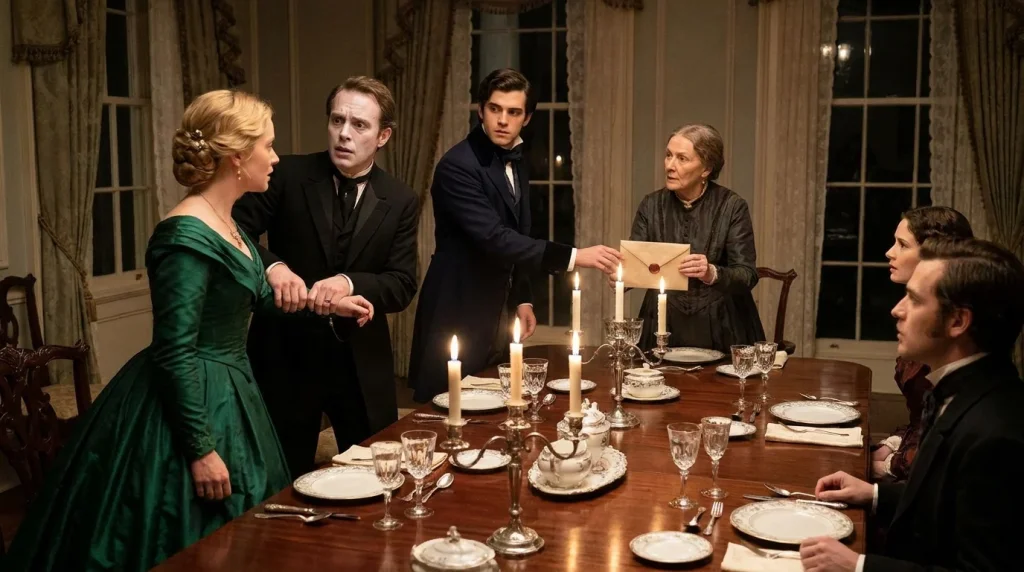
The mahogany table at Bellgrave Manor had been laid for fourteen, though only eleven guests had arrived. Candlelight shone against the silver, and the windows reflected the long room as if another family sat silently beyond the glass. At the head of the table, Edmund Vale watched his wife with the fixed attention of a man who believed every movement in his house belonged to him.
Clara Vale wore an emerald-green dress chosen for the evening by her mother-in-law. She had barely touched her soup. When she reached for the water glass, Edmund caught her wrist and pulled her sharply away from her chair. The silver spoon struck porcelain. Every conversation stopped.
“Let go! Everyone can see what you’re doing!”
Edmund’s fingers tightened. Before he could answer, his younger brother, James, rose so quickly that his chair fell backward. He stepped between them.
“You will not touch her again.”
Edmund released Clara, stunned less by the words than by their being spoken before the family. He called it a private matter and ordered James to sit down. James answered that the family ought finally to hear the truth.
Edmund went pale. “You wouldn’t dare.”
James reached inside his navy frock coat and removed a sealed envelope. He placed it in the center of the table. Their grandmother, Lady Agnes Vale, stared at the dark red wax. Her hand trembled as she lifted it.
“Where did you get this?”
Edmund’s face lost its colour. Clara looked from one brother to the other and understood that the envelope carried a secret older than her marriage.
A HOUSE BUILT ON APPEARANCES
Bellgrave Manor stood above the Susquehanna River, its stone terraces and white columns visible from the road. The Vale family had owned the estate for generations, and its name carried weight in county politics, banking, and the iron trade. Visitors admired the gardens, the portraits, and the servants who moved quietly through the halls. Few asked how the fortune had been made.
Edmund had inherited the title of family head after their father died. He was thirty-five, polished, confident, and skilled at turning disagreement into an insult. James, five years younger, had spent much of the Civil War serving as a quartermaster officer. He returned with a limp, a thinner face, and a growing suspicion that the family had changed while he was away.
Clara had married Edmund two years earlier. Her father, a Philadelphia merchant, had lost much of his fortune during the war. The Vale marriage offered security, and Edmund had promised to protect her remaining inheritance. The arrangement had seemed sensible to everyone except James, who had warned that his brother’s kindness often came with conditions.
Clara had learned to measure the household by its silences. The servants lowered their eyes when Edmund entered. Lady Agnes corrected every small breach of etiquette. James’s letters from the front had stopped arriving after his brother claimed he had requested no further contact.
The dinner confrontation was not the beginning of the trouble. It was the first time the trouble had become impossible to hide.
THE WOMAN AT THE WINDOW
After dinner, Clara was taken to the blue sitting room while the men argued in the library. Lady Agnes remained beside the fireplace, turning the sealed envelope over in her hands. She did not open it. She asked Clara whether James had told her what it contained.
Clara said he had told her only that it belonged to the family and that Edmund had no right to destroy it. Lady Agnes looked toward the window. “There are things a family keeps buried because the truth would ruin more than one man.”