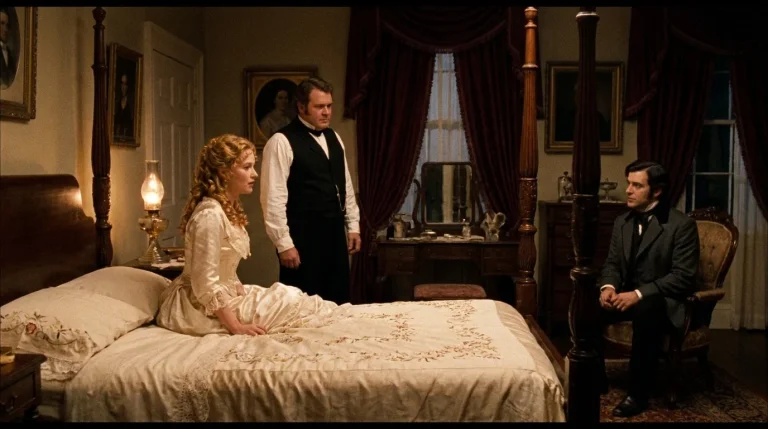
Clara asked whether James had known about the plan to declare her unstable. He said he had only learned of it that afternoon. He had found a draft report in Edmund’s desk.
She realized the bedroom assault had been about more than control. Edmund had been trying to force her signature before the envelope could be opened.
THE SEAL OF LADY AGNES
Lady Agnes entered the conservatory before James could explain the final page. She had followed Clara, not to stop her, but because she could no longer bear the burden of the secret. She examined the wax seal and confirmed it was the one used by her late husband.
The envelope had been sealed in 1862, when the first evidence of missing government supplies reached Bellgrave. Lady Agnes had witnessed the letter and hidden it after her husband begged her to protect the family until the war ended. She had believed the money would be restored.
Edmund later told her the shortage had been corrected. She had accepted the statement because she wanted the estate to survive. When James returned with questions, she had urged him to remain silent. She had not known the fraud had grown larger.
Clara asked whether Lady Agnes had known Edmund was trying to confine her. The older woman admitted that she had seen the physician’s draft report. She had told herself it was only a precaution. She had also known about the move from Clara’s private rooms to the smaller suite near the servants’ passage.
Lady Agnes began to cry. Clara did not comfort her. “You knew enough to stop it.”
The older woman lowered her head. “I knew enough. I chose the family name.”
That confession changed the envelope. It was no longer merely proof against Edmund. It was proof that the family’s most respected member had helped preserve the lie.
A FATHER’S LETTER
The next morning, Lady Agnes opened the envelope in the presence of Clara and James. Inside lay a letter from their father, a copy of the trust deed, and a schedule of payments made to Rook’s company. The letter explained that the Vale relief fund had been established after a furnace collapse killed nine workers. Its money was held for widows, injured men, and the education of their children.
The trust could not be used for family debts or political ventures. The estate acted only as administrator. Their father had discovered that money was being diverted through a supplier called Rook Industrial & Freight. He had ordered the transfers stopped and asked James to preserve the records.
The final paragraph was addressed to Lady Agnes. He feared Edmund had become involved with men who would use the family name to conceal their own crimes. He asked her to protect the trust, even if doing so meant exposing their son.
Lady Agnes said she had received the letter after her husband’s death. Edmund had told her the accusations were exaggerated and that James had misunderstood the accounts. She had accepted his explanation because she feared losing the estate.
Clara read the trust deed. Her father’s inheritance had been placed in a separate account, but Edmund had used the marriage settlement to gain control over the shares. The money was not his to claim.
The truth was worse than Clara expected: her marriage had been used as a financial instrument.
THE PHYSICIAN’S PAPER
Edmund had arranged for Dr. Hensley to visit Clara the following afternoon. The physician arrived with a polished case and a letter from the family solicitor. He asked Clara whether she slept, whether she felt anxious, and whether she had experienced unreasonable fears about her husband.