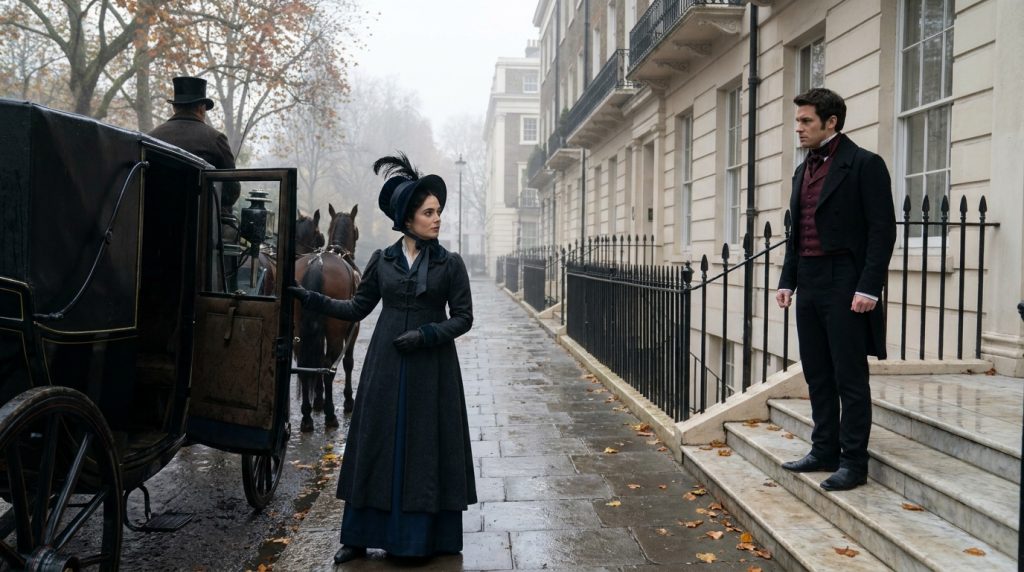
She did not scream. She did not throw the porcelain vases he had bought her in Paris, nor did she collapse in tears upon the Persian rug. She simply stood beside the open carriage door, the London mist dampening the feather on her velvet bonnet. She looked at him, truly looked at him, and gave him a smile that never reached her eyes. “Enjoy your new love,” she said, her voice perfectly calm. The heavy door closed, and the Duke of Rothbury realized that he had just lost the one thing that had kept him alive.
The carriage wheels scraped against the wet cobblestones, their harsh sound echoing through the otherwise quiet square. Alistair stood on the marble steps of Rothbury House. The rain grew heavier, soaking the shoulders of his wool coat, but he did not move. He watched the black lacquered carriage turn the last corner and disappear into the thick fog of the London evening.
He expected her to look back. For five minutes he stood there, utterly convinced the carriage would stop, its door would open, and Beatrice would step down, having calculated with her practical mind the social ruin her departure would bring upon her reputation. She never looked back. The carriage never stopped.
To the rest of fashionable society, theirs had been a triumph of an aristocratic marriage. Alistair, Duke of Rothbury, was wealthy, handsome, and profoundly proud. Beatrice was an earl’s daughter with a sharp intellect, a considerable dowry, and an air of gentle, understated grace. They had been married for nine years. Nine years of flawless dinner parties, meticulously managed estates, and quiet evenings seated opposite one another in vast drawing rooms. He had believed they were content. He had believed she understood the rules of their world.
The break had not come after a shouting match. It had begun forty-eight hours earlier, in the suffocating stillness of his private library. Alistair was sipping Scotch and watching the embers fade in the fireplace when the heavy oak door opened. Beatrice entered, wearing a simple dark-blue dress, her hair pinned up as neatly and decisively as always. She carried a leather-bound ledger.
She did not sit. She walked to his mahogany desk, placed the heavy book on the polished wood, and opened it at a page marked with a narrow silk ribbon. “Three thousand pounds, Alistair,” she said. Her voice neither rose nor trembled. It was exactly the tone she used to inform him that the roof of the east wing was leaking.
He stiffened, the Scotch suddenly tasting like ashes in his mouth. “I do not have to account for my spending to you, Beatrice. I had a rather unfortunate run at the tables at White’s.”
“You do not play cards at White’s on Tuesdays,” she replied quietly. She tapped a gloved finger against the inked entries. “And White’s does not issue deeds for townhouses in Mayfair. I went to the bank this morning. The draft was drawn directly against the principal estate account, the very account I have spent three years restructuring so we would not have to sell the Cornwall lands.”
Heat surged along Alistair’s spine. He rose, trying to use his height and physical presence to intimidate her. It was a tactic that worked on tenants, creditors, and fellow gentlemen. It had never worked on his wife. “This is a private matter,” he snapped.
“It ceased to be private when you used the money meant for the spring planting to buy a house for Miss Genevieve Rousseau,” Beatrice replied. She closed the ledger. The heavy covers struck together with a sound like a hammer falling.
He searched desperately for a defense and found only the tired, pitiable excuse of men in his position. “I am a duke. I have given you a perfect life. You have wanted for nothing. You are the Duchess of Rothbury. What I do beyond these walls is my own affair, provided I treat you with respect.”
“Respect?” Beatrice tilted her head, and for the first time a fierce emotion flashed in her dark eyes. It was not grief. It was utter disgust. “You call it respect to keep a mistress in a house bought with the money I saved for us? I have spent nearly a decade dragging your family’s finances out of the ruin your father left behind. I negotiated with coal merchants. I audited the tenant farms. I made you wealthy again, Alistair. And you used my work to buy another woman a bed.”