“One Day I Will Marry the Duke!” She Joked—Unaware He Was Listening Behind the Wall
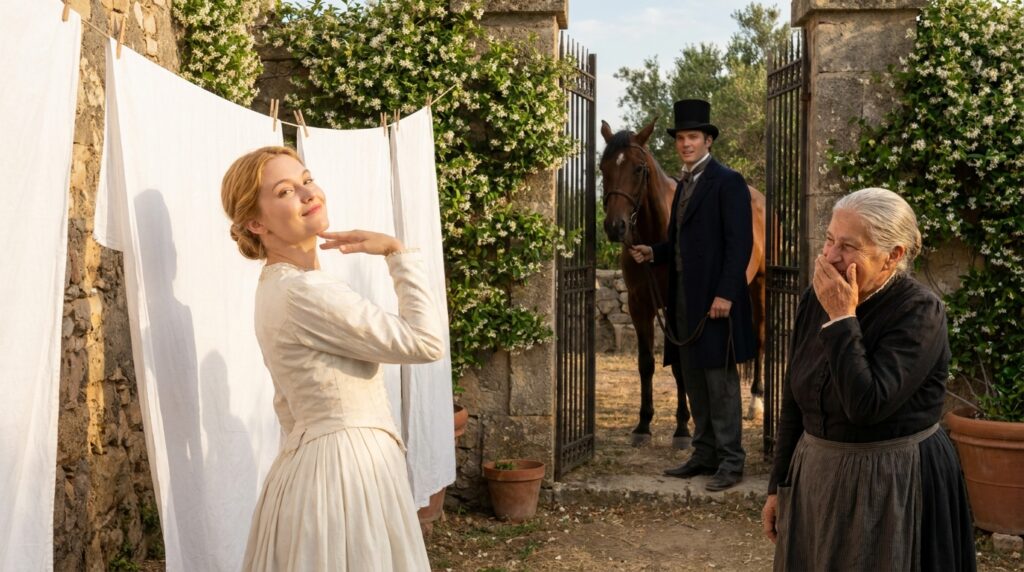
“One day, I will marry the duke,” the girl in the faded blue dress said, laughing among the sheets in the garden, unaware that on the other side of the jasmine wall, the wealthiest duke in Sicily heard every word.
This is the story of how a joke brought water back to a valley and a voice to a woman no one would listen to. On the other side of the stones, in the alley smelling of hot dust and horse manure, a tall man in a gray frock coat held the reins and stopped breathing to listen better. The girl kept laughing, the maid kept laughing with her, and the cicadas covered everything. No one there imagined that that joke would change two lives and an entire valley.
To understand that laughter, we must go back a few hours and climb to the mezzanine of the Vallefonda palace on a morning in August 1886. Noto was still sleeping under a milky sky. The baroque churches, rebuilt almost two centuries earlier after the great earthquake, held in their honey-colored stone the heat of the day before, and a distant bell rang.
Down below, the valley of almond trees was dying slowly. For weeks, the small farmers’ stone channels had been dry, because the springs and sluice gates of the hills belonged to a single lord, the Duke of Calastra, and the gates had not been opened for three summers. The gray-green leaves curled up at noon like closed hands, and dust rose from the roads.
In the narrow room under the roof, Viola Scardassi woke up before the heat. She was twenty-seven, with thick, dark brown hair, honey-colored eyes that the sun made almost golden, and light freckles on her nose. She washed her face in the cracked ceramic basin and pulled her hair into a low bun at the nape of her neck, letting the usual strands escape by her ears. Then she put on the only dress she was allowed to wear, made of indigo-blue percale so well washed it was already turning gray at the seams. The high collar closed with a row of tiny mother-of-pearl buttons, cold under her fingers, and the tight sleeves went down to her wrists.
Over her shoulders, she draped the straw-colored linen shawl. On her feet were her worn-out brown leather boots. The plain skirt without hoops barely made a sound as she walked across the room.
On the small table by the window, the marchioness’s account books, bound in wine-colored cloth, were waiting, and Viola opened them with the familiarity of someone praying. She dipped the pen into the glass inkwell, smelled the sour scent of the iron-gall ink, and in a few minutes, the fingers of her right hand were stained. It wasn’t numbers that were on those pages, but people. Viola knew that Turi Lobianco had seven children and a terrace that no longer bore fruit, that the widow Nunzia paid her rent with small almonds, and that the Gulino brothers had sold their mule in July. She knew every farmer in the valley by name, although none of them knew who kept those accounts.











