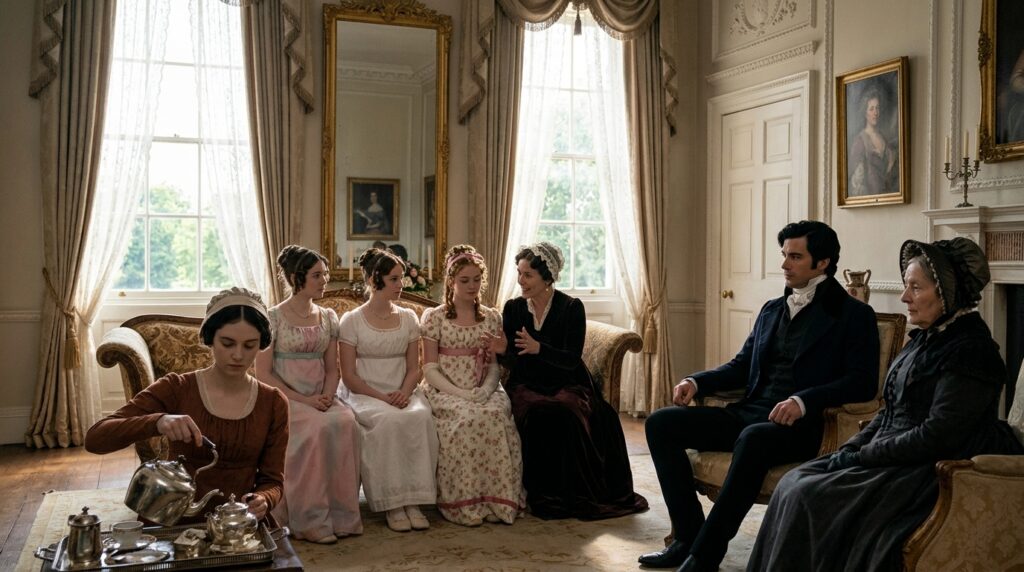
Into this arrangement at 3:00 on a Tuesday in early May the Duke of Ravensgate came. He sat opposite the row. He was offered tea and accepted it. And Cosima, who had arranged the seating with such thought, had arranged one other thing. She had ordered Diana to pour.
Diana was set at a low tray by the wall, half turned from the company. She was to pour and hand cups to the footman and go for hot water when Cosima signaled. She was to speak to no one. She was not to be introduced. She was, in the arrangement of the afternoon, the negative space against which the three daughters would show.
She was there to be poor and plainly dressed and evidently a dependent. And a woman with an aunt as generous as Cosima Marbury. Cosima had explained this to Diana that morning in three sentences that had left no room for reply. Diana had understood. Diana had, in truth, been prepared to understand at 17 and had been paying attention ever since.
She came back with the hot water and refilled the pot at the low tray. She sat with her small pale hands in her lap and looked at the tea things and not at the Duke. She had trained herself over 7 years not to look at male visitors. It was easier for everyone.
The Duke had noticed her. He had noticed her at the moment of the pinch. He had not seen the pinch itself. He had seen Diana’s shoulder move a very small fraction and had seen her face briefly, quite still. He had watched her rise and had watched the footman try to open the door for her and be waved off because Cosima did not want anyone opening doors for the poorer.
He had watched her go without a word. He had noticed something else, too. Though he could not yet have said what. He had noticed that the three young ladies, when they spoke, spoke as if they had been coached. Priscilla answered questions with sentences arranged as neatly as flower baskets.
Jemima laughed at the end of Priscilla’s sentences. Alice looked at her lap. There was nothing wrong with any of it. There was also nothing in any of it that a serious man might build a life on. He answered the questions he was asked.
He asked in return, the polite ones. He was told by Cosima, at some length, of Priscilla’s accomplishments. He was told of a screen Priscilla had painted, and a song Priscilla had learned, and a shawl Priscilla had knotted for a favorite cousin. He was told that Priscilla was much admired at Almack’s. He nodded gravely.
He turned to Alice and asked whether she read. Alice said softly that she did. He turned to Jemima and asked what she had been reading lately. Jemima said, with a nervous glance at her mother, a novel of Miss Edgeworth’s. She had not, in fact, been reading a novel of Miss Edgeworth’s.
She had been reading Virgil in a corner of the schoolroom under Diana’s finger. But she had learned early not to say so. Cosima was pleased with this. She thought it went as well as any first tea could be expected to go.
She had not seen the Duke’s face when Diana rose. She was, in the arrangement of her own drawing room, entirely occupied with the front row. That was the design of the afternoon. It was also its flaw.
The Duke stayed the full civil half hour. He drank two cups and praised the tea briefly. He said nothing at all about the young ladies. He bowed to his mother and helped her to her feet.
In the hall, as he waited for his cane, Diana passed once behind him with a tray. He turned his head very slightly, but did not speak. She did not look up. Then she was gone.
In the carriage, he was silent a long moment. His mother, who was accustomed to his silences, said nothing at all.
At last, he said quietly, “Not Priscilla.”
His mother said, “No.”
She said it exactly as one says no to a bolt of cloth one does not want.











