Harriet said nothing. She was thinking of an old woman in a cottage by the church who mended nets with her fingers because her eyes were too poor to see the twine. She was thinking of a promise she had made at 14 sitting on a stool in that cottage with the register’s story still new in her head.
“My mother wanted nothing from that house, child, and I want nothing, either. Let it lie.”
She had let it lie for 10 years. She looked up and found Mr. Fairlie watching her, and she had the uncomfortable feeling that he had seen her think of something and decide not to say it.
“I can show you the register tomorrow,” she said. “It is kept locked in the vestry chest. If you come at 9:00, the light will be good, and the weather will have blown itself out by then.”
“How do you know?”
“Because it always does, the week before Michaelmas,” said Harriet. “It comes in hard, and it goes out by morning, and it leaves the beach covered in weed and the lanes full of mud. I have lived here all my life, Mr. Fairlie. I know what the sky is going to do.”
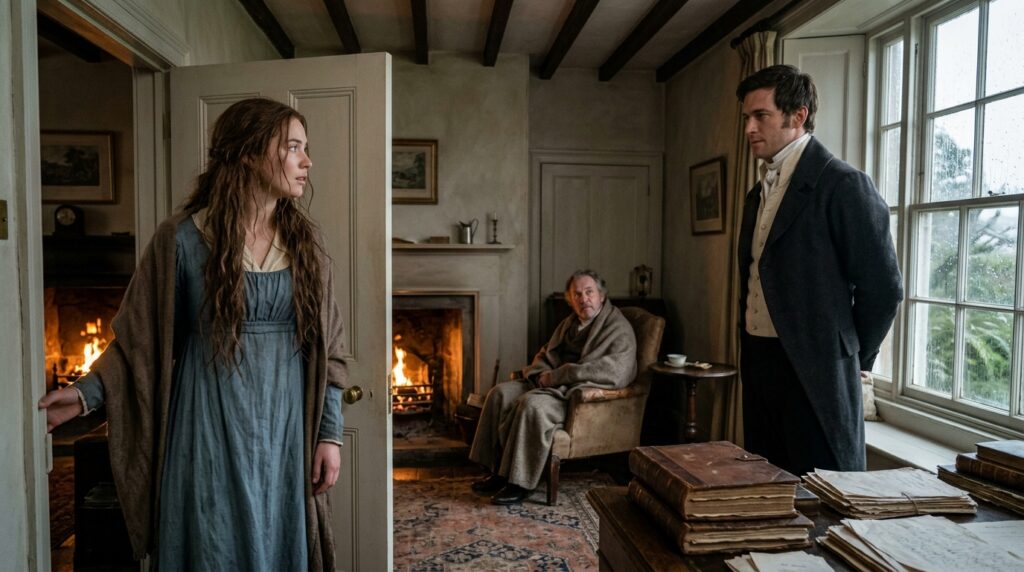
She stood up, and her wet skirts clung to her ankles, and she was suddenly very conscious of how she must look.
“Now, I must go and get dry, or I shall be no use to you tomorrow at all.”
He bowed again. At the door, she glanced back, and he was still watching her, and his face was perfectly serious. But, she could have sworn that he was trying not to smile. The weather had blown itself out by morning, exactly as she had said. The sea lay heaving and tired under a washed sky.
The lanes were full of mud. The beach was heaped with brown weed, and the air smelled of salt and broken bracken. Harriet put her hair up with every pin she owned. She told herself it was because of the wind.
She took the great iron key from its hook in her father’s study and walked up the lane to the church. And Mr. Fairlie was already waiting at the lychgate with her lost bonnet in his hand. He had found it caught in the hawthorn hedge on his way up from the inn. It was ruined beyond saving.
She thanked him for it as gravely as if it had been a crown. The vestry was a small stone room on the north side of the church, cold even in summer with a single window of old greenish glass. The parish chest stood under it, a black oak box bound in iron with three locks. She opened it and lifted out the oldest book.
It was bound in brown calf, gone soft as cloth and it smelled of damp stone and old candle grease. And she set it on the table under the window with the care of someone handling a sleeping child. Mr. Fairlie stood beside her. She could feel the warmth of him at her shoulder and she moved a little away and opened the book.











