That night, for the first time that winter, she lay awake, not because she was cold or tired or afraid, but because she was happy and did not know what to do with it. Lavinia came to the still room the next morning. She came in quietly for once, and she did not touch the sugar. She laid a small purse of soft leather on the end of the table, where it chinked.
“Your wages, Miss Eldridge,” she said. “Up to Twelfth Night and a little over. His Grace asked me to give them to you once he was safely away. He did not want a scene.”
Eliza looked at the purse. She did not touch it.
“I do not understand you, madam.”
“No? Then I will be plain. Since he could not be, the county is talking about his night at your farm. The gentlemen he needs for his road are talking. He cannot have the girl who makes his sugar sitting at his table on Twelfth Night, with half the county whispering behind their fans. He was very kind about it. He said you had served your turn and served it well. The housekeeper can finish the ices.”
Every word of it was exactly what Eliza had always told herself would happen. That was the worst of it. She had walked 12 miles each way, so that nobody could ever say she had slept under a duke’s roof. She had kept her name as carefully as she kept her sugar.
And one night of snow had undone it. And he had seen it undone and gone to York. She stood with her hands flat on the cold marble and felt the room go far away.
“Thank you for telling me, madam,” she said.
Her voice sounded quite ordinary. Lavinia looked at her for a moment as if she had expected something else, tears perhaps. Then she went out and left the purse behind her on the table. Eliza packed her grandmother’s copper pan in a basket with her knives and her molds and the little jar where the three candied oranges lay in their syrup. She left the purse where it was.
She went to the orangery and stood for a minute beside her father’s tree, which was green again at every tip in the warmth. She could not carry a tub up 12 miles of snow. She would send for it in the spring when the track was open. She touched one of the dark leaves. Then she went out by the scullery door because Lavinia had said that was the door for people like her.
And she would not give Lavinia the satisfaction of being told twice. She did not take the pony. She would not ride the duke’s pony home after being dismissed from the duke’s house. So she walked. The snow had begun again, soft and thick.
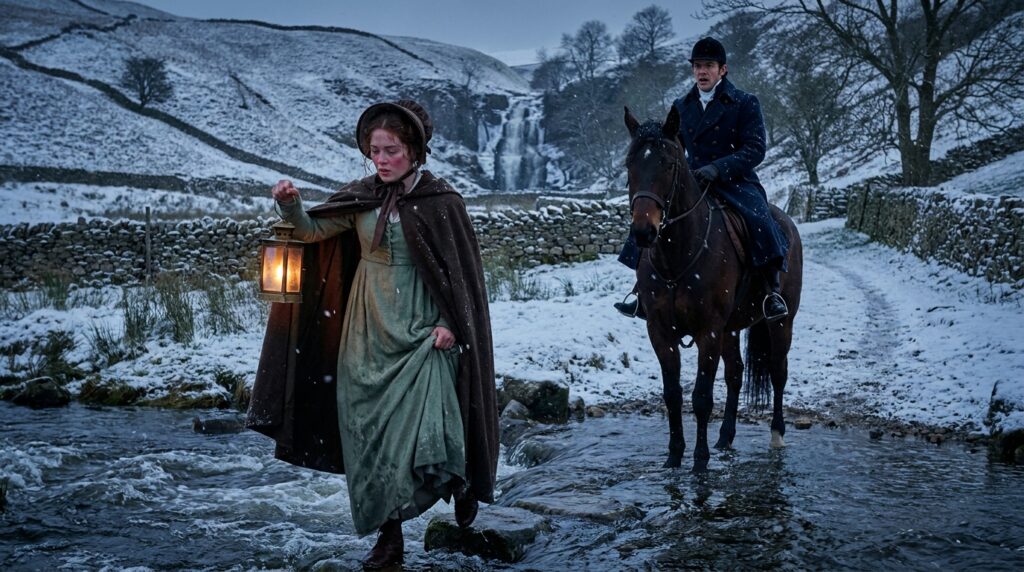
And by the time she reached the Force, her skirts were heavy with it. The waterfall roared down through its beards of ice, and she stood for a moment in the noise of it and let herself cry because nobody could hear her there. Then she went on. At the stone barn, she did not stop. At the ford, the stones were clear, and she crossed them carefully, one at a time, and did not let herself think about the night he had shouted at her to stand still.
It was full dark when she came to the farm. Maud was at the door with the lantern, as she always was. She put out her hand and felt Eliza’s face, and her fingers came away wet, and she did not say anything about it. She took the basket and brought her into the fire. Later, when Eliza had told her all of it, sitting on the settle with her hands round a cup she did not drink, Maud was quiet for a good while.











