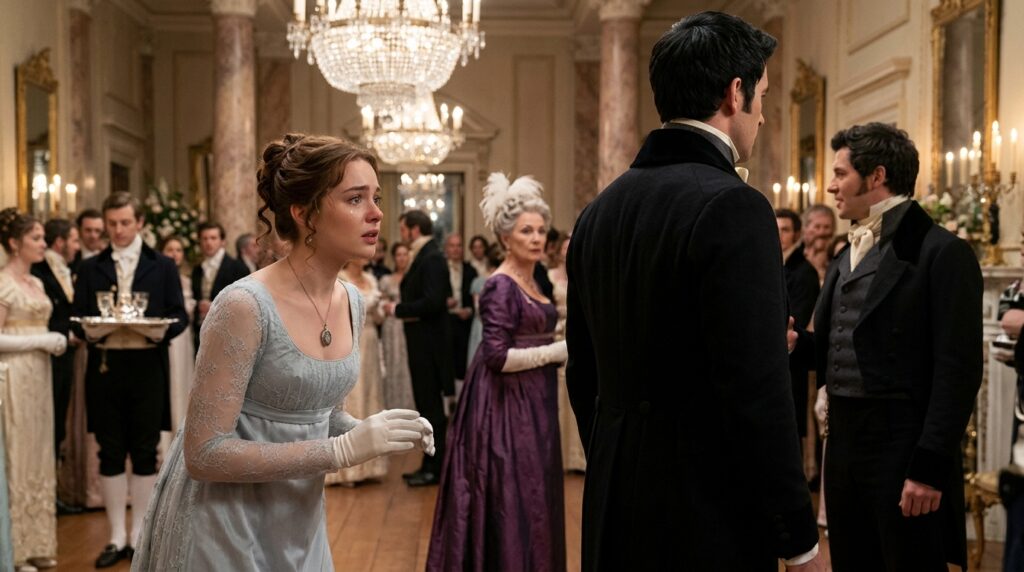
They did not reach Sussex by some miraculous turn of a page. There were arrangements to make, letters to send ahead, an early coach to catch, and uncomfortable hours in which the road repeatedly reminded Eliza that human bodies were less resilient than carriage springs. Lady Agnes traveled beside her, alternately commenting upon the countryside and sleeping beneath a sensible bonnet. Near Chichester, they took rooms with a respectable household known to their hostess. Sebastian had traveled separately on charity business with Isaac to assist in the account inquiry and their first meeting in Sussex occurred in a drawing room under the eye of a housekeeper who had seen more than enough of the world to be impressed by rank.
The former lodging yielded disappointment. Harriet had left some time before, paying what she owed and giving only her mother’s family surname as a direction for correspondence. The innkeeper remembered her quiet manners and careful accounts. He did not know where she had gone.
“We have come a considerable distance to learn that an absent woman remains absent,” Lady Agnes said as they returned.
Eliza smiled tiredly.
“That is still more than we knew yesterday.”
The afternoon rain made any further calls unwise. At Lady Agnes’ suggestion, they gathered in the drawing room where a square piano stood beside a window overlooking wet grass and a line of bare-limmed trees. Sebastian studied a small framed landscape over the mantel.
“My brother used to say the hills looked like sleeping animals,” Eliza said.
“Which animals?”
“Whatever he hoped to eat for supper.”
Sebastian laughed, not loudly, but with genuine surprise. Eliza had never heard him laugh before. It changed the shape of his face.
“Was he always so irreverent?”
“Only when awake.”
They talked about painting, then about music, then about nothing especially useful. Eliza confessed that she had once imagined opening her own studio, where apprentices could learn careful handling of old miniatures, and patrons might commission work without requiring an introduction from a noble household. After William disappeared, the plan had become a luxury she postponed each season.
“What would the room look like?” Sebastian asked.
“North-facing windows, a worktable large enough that no one could knock into my brushes, cabinets with proper drawers, and a small sign at the door bearing my own name, no coat of arms, not unless I am secretly descended from a very artistic duchess.”
He did not offer to purchase the building. She noticed the absence of the offer and was unexpectedly grateful. When the fire began to smoke, Sebastian rose to open the narrow window before a servant could be called. A gust scattered Eliza’s sketches across the rug. They knelt on opposite sides to collect them, and he paused over one showing a crooked shop sign and three absurdly ambitious windows.
“You have drawn the room already,” he said.
“Only a dozen times. This is the least impossible version.”
He returned it without correcting a line.
“Then I hope you find a room worthy of it.”
What warmed her was not the compliment, but the care with which he held the paper.
“You speak as though your future has been waiting for permission,” he said.
“It has been waiting for money, time, and the courage to imagine I might have a life not organized around an absence.”
She looked toward the window.
“And yours?”
“My future?”
“What does it look like when it is not composed of duties?”
He appeared genuinely perplexed.
“I have not thought about it.”
“Then perhaps you should practice.”
After a long silence, he told her of a younger relation, now dead, who had once begged to join a summer visit to the sea. Fearing illness and bad roads, he had forbidden it. She had teased him for being as solemn as a bishop, then spent the summer at home. He had told himself he had kept her safe. Months later, when she was no longer there to argue with him, he understood that he had taken something joyful and ordinary from her for a danger that might never have happened.
“I cannot know that the journey would have been safe,” he said. “But I know I gave her no voice in deciding.”











