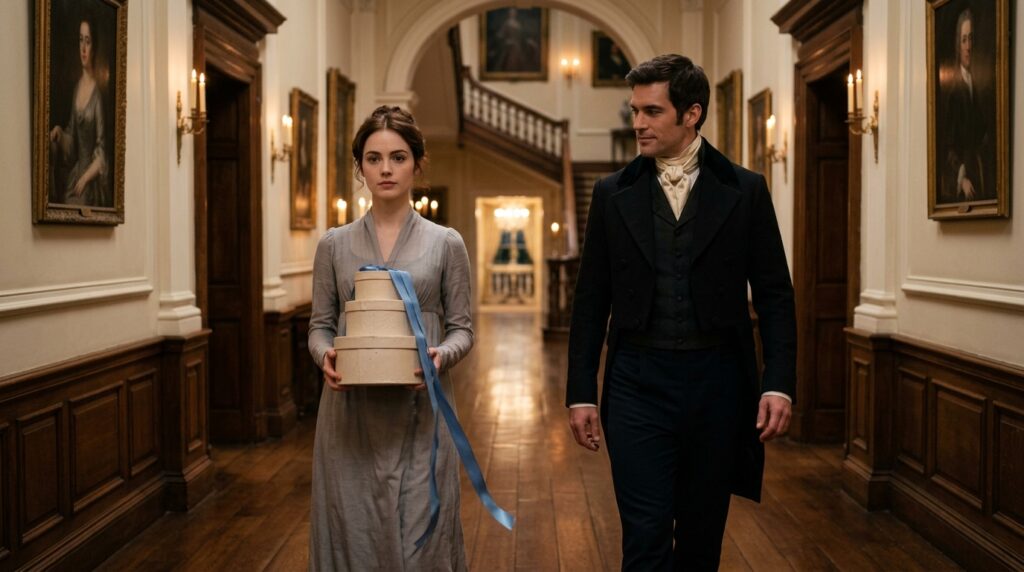
That evening, when the dressing bell rang at 6:00, Verity walked up the stairs beside Lydia. As soon as they reached the upper corridor, Lydia turned toward her own bedchamber door as usual and held out a crumpled white satin sash.
“The iron was not quite hot enough yesterday, Verity,” Lydia said, her tone brisk and slightly fretful after her afternoon at the instrument. “If you press this out for me first and bring the pearl net for my hair by half past 6:00, we can try looping the curls higher at the crown. I am sure His Grace did not come near the pianoforte today because the room was too crowded by the fire, and tonight we are to have cards and music in the saloon.”
Verity looked at the white ribbon in her sister’s outstretched hand and then down the corridor toward her own room, where the late red light of sunset was still shining across her writing table and the unfinished sketch of the yew archway she had begun before tea. For the first time since they had packed the trunks at home, she did not reach out to take the sash.
“I have already laid out your blue silk gown and your pearl net on the dressing stool, Lydia,” Verity said evenly. “If you ring for Susan, the housemaid on this wing has an iron heated in the pressing room and will smooth the sash in 5 minutes. I am going to wash my hands and finish a drawing in my own room before I dress for dinner.”
Lydia stared at her, her hand remaining suspended in the air with the satin trailing from her fingers.
“A drawing? Now, when the dinner bell will ring in three-quarters of an hour? What can you possibly need to draw before dinner, Verity? You know the maids never pin my hair as smoothly as you do.”
“Susan pins very neatly if you sit still for her,” Verity replied without sharpness, though her voice was entirely firm. “I shall see you in the drawing-room at quarter to seven, Lydia.”
Walking down the hall to her own door, Verity felt the light weight of the sketchbook in her pocket and realized, with a quiet steadiness that surprised her, that she was looking forward to the evening not because her duties were finished, but because Hugh had asked her at tea what she thought of the library portraits and she wanted 20 quiet minutes to herself before she went down to tell him.
By the fifth day of the visit, the autumn weather had settled into a clear, golden stillness that drew the house party out toward the Home Wood after luncheon. Aunt Ruth walked along the broad carriageway with Lady Linton while 50 paces ahead of them, entirely visible between the rows of chestnut trees, Hugh walked beside Verity. He had asked the head gardener that morning to mark the yew hedge where Verity had suggested the new arch and as they approached the southern slope, two stakes with white twine stretched between them already showed where the opening would be cut. Hugh stopped beside the twine and looked at the view toward the pond that would soon be revealed.
“When a man has lived in the same house since boyhood, Miss Bellamy,” he said, “he begins to assume that every wall and path must remain as he found it simply because no one has ever suggested otherwise. Over the last 5 days, I have realized that the house was not finished at all. It was merely waiting for someone with sharper eyes than mine to walk through it.”











