THE WIDOW OF RED MESA: Seven Riders Came to Claim Her Daughter’s Ranch — But the Old Mother Had Not Forgotten How to Fight
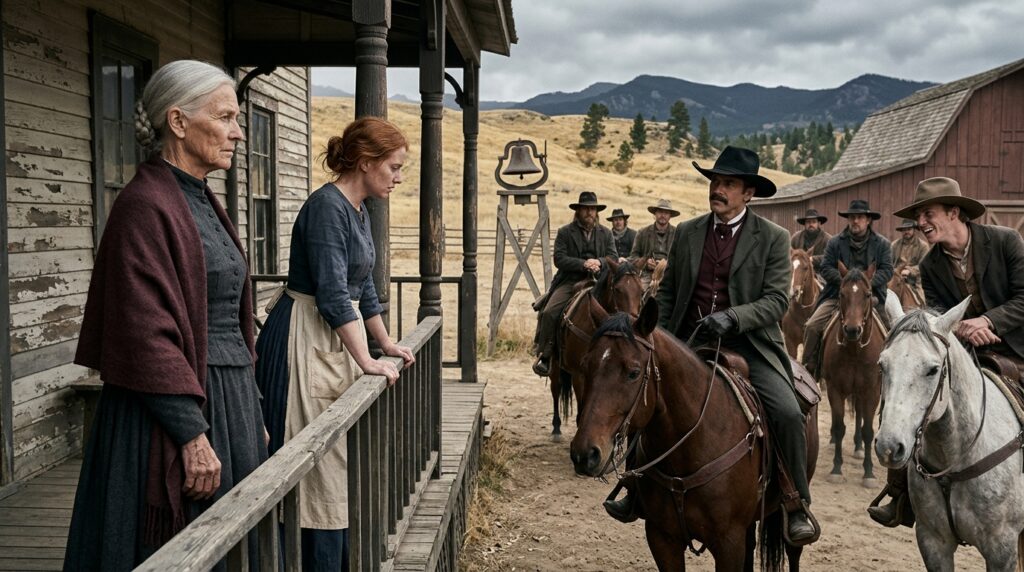
The riders arrived at the Calder place just before noon, seven horses raising a pale cloud along the county road. On the porch, Ruth Calder stood beside her daughter, Anna, with one hand resting on the doorframe. Ruth was sixty-eight, silver-haired, and dressed for a day of mending rather than a fight. The man in the lead tipped his hat without kindness.
“We have come to finish the business your husband left unfinished,” he said. Anna’s face tightened. Her husband had been dead eleven months, and every visit from these men brought the same demand: sign away the spring pasture and the narrow pass beyond it. Ruth looked at the riders, then at the rifle leaning just inside the doorway.
“You came with seven guns to discuss a paper?” she asked. A young rider laughed. The leader did not. He had expected a frightened widow. Instead, Ruth stepped inside, lifted the rifle, and returned to the porch. The laughter stopped when she worked the lever and asked which man had been sent to speak for the others.
Three weeks earlier, Anna had still believed the trouble could be settled with patience. Her husband, Daniel, had left her a modest ranch in the Colorado Territory, a weathered house, forty head of cattle, and a spring that never failed even in the driest August. The spring fed a shallow creek that crossed the lower meadow before reaching two neighboring homesteads.
Daniel had considered that water a responsibility, not a fortune. He had allowed the neighbors to draw from it during dry months and kept the arrangement in writing. After his death from a winter fever, the county surveyor arrived with a new map. It showed the spring inside a parcel claimed by the Red Mesa Land and Cattle Company.
Anna knew the boundary was wrong. Daniel’s deed was clear, and the old stone marker stood where it always had. But the company had money, lawyers, and men willing to ride out after dark. Anna had none of those things. The first notice gave her ten days to accept a payment far below the land’s value.
She carried the notice to the county office, where Deputy Harlan Pike advised her not to make enemies she could not afford. He spoke gently, almost kindly, but his eyes never left the company seal. Anna returned home with the paper folded in her pocket and the certainty that the law might not protect her unless someone made it look.
The next morning, she found the creek gate broken and the lower meadow trampled by unfamiliar horses. A length of wire had been cut from the fence, and a fresh wagon track crossed the wet ground near the spring. Anna followed it as far as the ridge, where she found a brass button stamped with the initials R.M.
She placed it beside Daniel’s old survey notes. The button proved little by itself, but the track had been made after the rain, and the prints were too wide for the ranch horses. When she showed the evidence to Pike, he told her the company had permission to inspect the boundary. Anna asked to see the permission. He said the document was at the courthouse.











