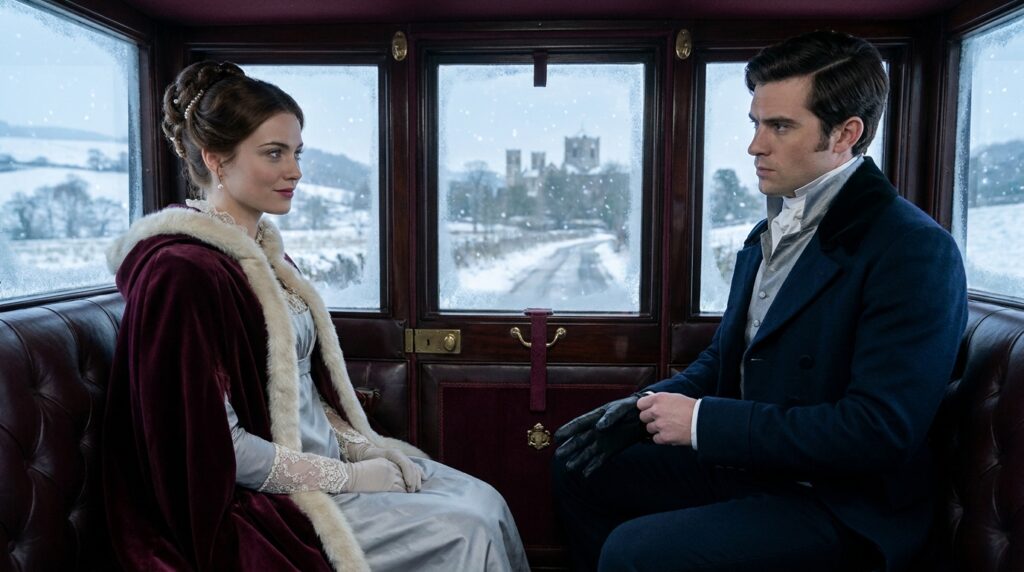
The bells of Hexham Abbey were still ringing when the Duke of Calderwood shut the carriage door and turned to the woman he had married 11 minutes earlier.
“Understand this before we reach the hall,” he said, pulling off his gloves one finger at a time. “There is a lady in Newcastle who has held my heart for 9 years. Nothing you do will change that. She will always come first.”
His new duchess did not lower her eyes. She did not reach for a handkerchief. She simply folded her hands over the gray silk of her wedding gown, looked out at the green hills of Northumberland rolling past the window, and smiled.
“Perfect,” she said. “Then we shall understand each other very well.”
It was the second week of May, in the year 1821, and nobody in the carriage yet knew what that single word would cost. Edmund Rowell, sixth Duke of Calderwood, was 32 years old, and had never once been told no by anyone who mattered. He was dark-haired and long-limbed, and had been bowed to since the cradle. He had not wanted this marriage. He had been ordered into it by a dead woman.
His grandmother, the Dowager Duchess Margaret, had ruled Calder Hall for nearly half a century, and when she died the previous autumn, she left a will that her solicitor, Mr. Grace of Newcastle, read aloud with visible discomfort. The title and the entailed lands would pass to Edmund, as the law required. But the hall itself, the home farm, the woods, and the 12 tenant farms she had bought with her own fortune were hers to give. They would go to her grandson only if he married within one year of her death a young woman she named in the document. If he refused, every acre and every stone of the house would pass to the infirmary in Newcastle.
The young woman was Miss Theodora Ashcombe, the daughter of a land surveyor who had measured half the parishes of Cumberland and died two winters earlier, leaving his only child a box of instruments, a cupboard of unfinished maps, and very little else. The Dowager had been her godmother. Edmund had met her exactly twice before the wedding, once at the reading of the will, and once in the vestry to sign the register. Both times she had looked at him with a calm, measuring attention as though he were a stretch of ground she had been asked to survey and had not yet decided how to draw.
And now she had answered the cruelest sentence he could devise with a smile and a single word. He spent the rest of the journey waiting for her to cry. She spent it reading a small leather notebook and occasionally making a mark in pencil.
Calder Hall stood on a rise above the South Tyne, a long house of honey-colored stone with tall sash windows and a clock tower over the stable yard that had not kept the right time in living memory. The servants lined the gravel to greet the new duchess. They had expected a frightened girl. What stepped down from the carriage was a slender woman of 25 with a straight back, heavy brown hair pinned without fuss, and a face too decided to be pretty in any fashionable way. Her brows were dark and level, and her eyes moved over the house, and the line of servants as if she were already measuring distances.











