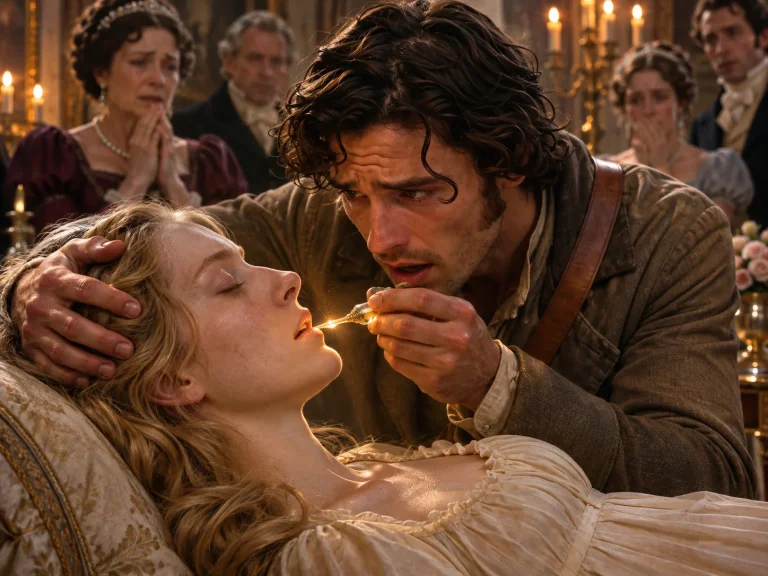
“Your Grace, what an honor. We had quite given up hope. Do come in. You must meet the bride.”
“Thank you, Lady Harriet.”
The Duke bowed.
“My congratulations to the bride and her husband, but I have come on a matter of business and I am afraid it will not wait.”
“Business?”
Lady Harriet’s smile flickered.
“Today? Surely, Your Grace.”
“Today,” the duke said. “May I present the Reverend Mr. Josiah Hale, for 11 years curate of Little Hartwell under the late Reverend Thomas Whitmore. And Mr. Simon Garrick, solicitor of Lincoln’s Inn.”
Eleanor by the punch bowl felt her breath stop. Mr. Hale had taught her to fish in the millpond and read the lesson at her father’s funeral. He found her face across the crowded room and smiled at her with such gentle warmth that her eyes stung.
“Mr. Garrick,” the duke continued, in the same calm, carrying voice he had used at dinner a week before, “has been reviewing, at my request, the affairs of the late Reverend Whitmore, in particular, his will, which was proved in this county in March of 1805.”
Lady Harriet’s hand had gone to her throat.
“I don’t see what possible business…”
“It seems,” said Mr. Garrick, opening his portfolio, “that the late Reverend Whitmore was not as poor as was generally believed. He held shares in a small canal company in the north, bought as a young man with a legacy from his godmother. In 1803, the canal was joined to the Grand Trunk and their value rose considerably. At his death, the holding was worth a little over 6,000 pounds. He left it entirely to his daughter in trust until her 25th birthday or her marriage. The trustee he named was his wife’s sister, Lady Harriet Crane.”
A murmur went through the room like wind through wheat.
“Miss Whitmore turned 25,” Mr. Garrick went on, “five years ago. The trust should have been dissolved at that time and the capital paid over to her. It was not. Instead, the dividends from the shares, which have amounted to approximately £300 per annum for the past 11 years, have been paid each quarter into an account at Hoare’s Bank. That account is in the name of Lady Harriet Crane.”
Somebody dropped a glass. It shattered on the parquet floor, and no one moved to pick it up. Eleanor put her hand flat on the table because she needed something to hold.
£6,000. She had been told she was a pauper. She had been told it every day for 12 years.
Poor Eleanor. Not a penny. She looked at her aunt. Lady Harriet’s face had gone the color of old ashes. She opened her mouth, closed it, opened it again.
“This is… This is absurd. A misunderstanding. The money was being kept safe for her. For her own good. She has no head for business. She would have squandered it. Some fortune hunter would have…”