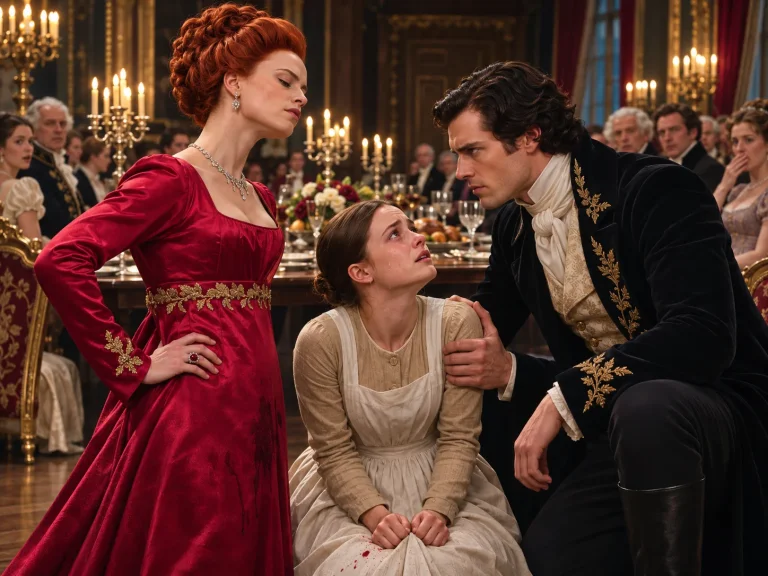
She raised her eyes. He was older. Of course he was older. There were lines at the corners of his eyes and a thread of silver at his temple. And his face was leaner and harder than she remembered.
As though the years of war had carved away everything that was not necessary. But his eyes were the same. Dark gray, like a sky before rain. And they were looking at her exactly the way they had looked at her under the apple tree.
“I have looked for you,” he said, “for a very long time.”
She could not speak. She opened her mouth and nothing came. And to her horror, she felt her eyes fill with tears there at the table, in front of everyone, in front of her aunt.
She stood up so suddenly that her chair scraped on the floor.
“Forgive me,” she whispered. “Forgive me. I am unwell.”
And she turned and walked out of the dining room as quickly as she could without running and did not stop until she had reached the cold dark conservatory at the back of the house, where her aunt’s orange trees stood in their great tubs and the moonlight came in silver through the glass.
She stood among the orange trees and pressed both hands over her mouth and shook. She did not know how long she stood there. 5 minutes?
10? Long enough for the worst of the shaking to pass. Long enough to hear behind her the soft sound of the conservatory door opening and closing again.
“Please go away,” she said without turning around.
“I have been away for 12 years,” the Duke said. “I find I have no more talent for it.”
She turned. He was standing by the door, a tall dark shape against the glass, not coming any nearer.
“You should not be here,” she said. “My aunt will be furious. People will talk.”
“People are already talking. I made very certain of that.”
He paused.
“I did not mean to distress you, Eleanor. I had a great many fine speeches prepared, and then your aunt said what she said, and they all laughed and you smiled as if you were used to it.”
His voice roughened.
“I could not bear it. I’m sorry. I should have waited.”
“You should have waited,” Eleanor said, and from somewhere deep and long buried, a flame of anger rose up in her, hot and astonishing. “You say that to me? I waited, Alexander. I wrote to you every month for a year after Papa died, when I had no one in the world, and you never answered. Not one line. And then I heard you had found a lady with a fortune in Lisbon. You might have written once, just once, to say goodbye. Instead, I have sat at her table for 12 years as the poor relation who was jilted by a soldier. And now you walk into her dining room and say you’ve been waiting for me? Waiting for what?”