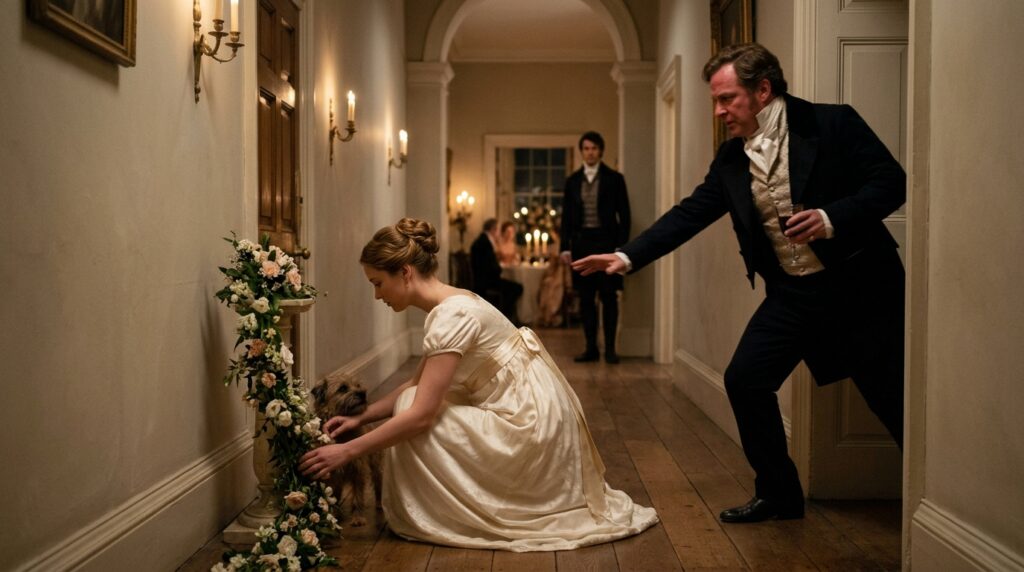
Lord Silas Fenn did not notice her until he had already shoved her. He had come through the side corridor of Hartwell House with a full glass of claret and an argument still hot in his chest from the card room. The woman was crouched near the baseboard of the hall helping a small terrier that had somehow wandered in from the garden and gotten tangled in a trailing flower arrangement. She did not hear him coming. He did not slow down.
“Out of the way,” he snapped.
The glass pitched sideways. A dark red arc of claret caught the hem of her ivory gown before she could move. He grabbed her shoulder with his free hand and shoved her back against the wall hard enough that she struck it with both shoulders at once. She slid down slightly. The terrier bolted.
“Stupid girl,” said Fenn.
He looked at his own ruined cuff and not at her at all.
“What are you doing on the floor in a corridor? Have you no sense? Go find a mop.”
She pressed one hand to the wall behind her and straightened. Her gown was ruined at the hem and stained a dark wine red. Her expression was very still in the way a person’s expression goes still when they are deciding something. She said nothing.
Fenn did not wait for a reply. He never did. He walked on.
30 people had been within sight of that corridor. Every one of them found somewhere else to look. Lord Silas Fenn was not a man anyone in Hertfordshire or London crossed in public.
He had sat on the county magistrates’ board for 9 years. He made substantial donations to the society for the improvement of parish roads. He was considered by the people whose opinion he valued to be a man of considerable weight.
He was not yet aware that the woman he had just shoved against the wall and called stupid was Vivian Hartwell, Duchess of Lorne. She had been married 4 weeks and 2 days. She was the daughter of a Shropshire banking family, third of five children, raised in a house where money was counted carefully and comfort was something you earned by Tuesday. Her father, Mr. Archibald Bourne, had taught her bookkeeping at his own desk before she was 12.
He had not bothered with a governess. He did not believe women needed to be taught how to be ornamental. He believed they needed to know how things actually worked. He had taught her one other thing at that same desk in his measured and practical way.
He said that a person who stays quiet when a wrong happens in front of them is not being polite. They are making a choice. And choices, he said, have a way of compounding.
Vivian had never expected a title. She was 24, pleasant-looking rather than beautiful, good at figures, and perfectly aware that the world of great houses was not the world she had been born into. She had met Arthur Hartwell, Duke of Lorne, at a dinner her father’s bank had arranged for several clients of particular standing. The Duke had sat across from her and spent the entire meal ignoring the woman beside him to argue with Vivian about crop rotation financing and whether the standard terms for agricultural lending made any practical sense at all. They had argued well past the cheese course.











