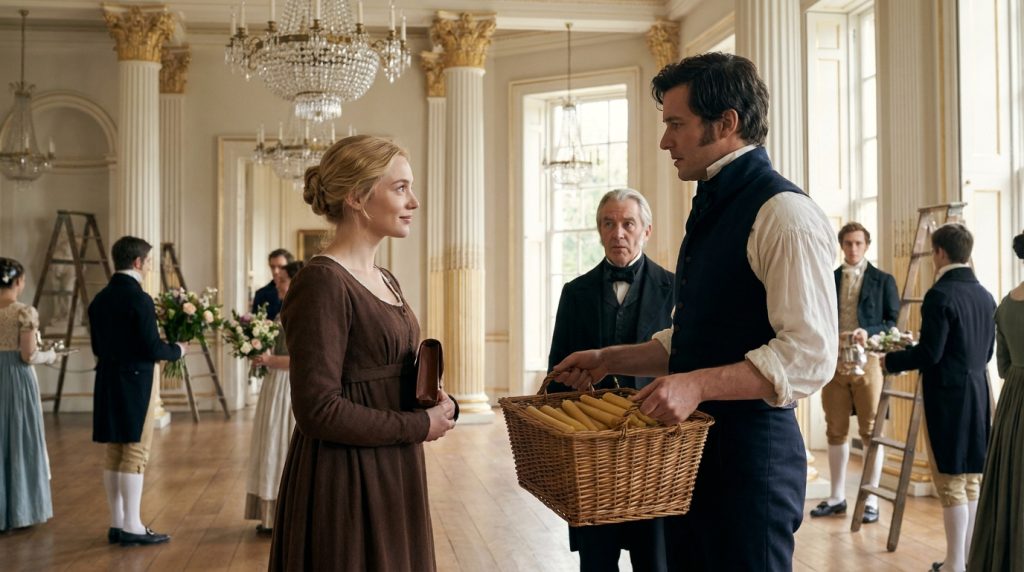
The first time the Duke of Wickliffe spoke to Lydia Harcourt, he pushed a basket of wax candles into her arms and told her she was late. It was a quarter past two in the afternoon, and Wickliffe House was coming apart at the seams. Footmen ran up the back stairs with armfuls of linen. Two maids were on their knees in the long gallery, polishing the floor with beeswax and their own breath. In the hall, a carpenter’s boy stood on a ladder with a hammer in his teeth, while the butler shouted up at him to mind the paint.
Somewhere below, a kitchen maid had dropped a whole tray of glasses, and the sound of it was still ringing through the house like a bell nobody had meant to ring. And in the middle of all of it stood Alexander Wickliffe, Duke of Wickliffe, 35 years old, with his coat off and his sleeves pushed to the elbow, holding a list of things that had gone wrong since breakfast. It was a long list. In 6 hours, 300 people would walk up the front steps of Wickliffe House, lords and ladies, two cabinet ministers, bankers from the city, and four men in particular who had money enough to save the Wickliffe name if they chose to. That was what the ball was really for.
Everyone in London knew it, and nobody said it out loud. The old Duke, Alexander’s father, had died 3 years before. He had left his son a title that went back to the Tudors, four great houses, a colliery in Durham, and debts that would have made a moneylender blush. Alexander had spent 3 years selling paintings, closing wings, cutting horses from the stables, and paying back every penny he could. And then he had made one great gamble.
He had borrowed against the colliery to rebuild the ballroom of Wickliffe House, so that he could open his doors to the men he needed and show them a family that was not finished, a family worth investing in. If tonight went well, those men would fund the new iron railway from his colliery to the sea, and the Wickliffes would stand on their own feet again. If tonight went badly, London would smell blood, and London always came back for more. It was Mr. Hadley, the butler, 55 and devoted, and at that moment very red in the face.
“Your Grace, the extra girl from the registry office still hasn’t come. Mrs. Pember is beside herself. There’s no one to set the candles in the ballroom sconces.”
“Then find someone.”
“There is no one, Your Grace. Everyone is doing three things already.”
Alexander closed his eyes for half a second. It was all the rest he’d had since dawn.
“Then send her to me the moment she arrives.”
He turned back to his list. Four lines down, written in his own hand, was a word he had underlined twice, gallery. He did not yet know why it worried him. He only knew that every time he walked under it, the back of his neck went cold. Six miles away, on the Great West Road, a hired coach was trying very hard to reach London before the light went.
Inside sat a young woman in a plain brown traveling gown, a gray wool cloak, and gloves that had been mended twice at the thumb. On her lap she held a leather case, square and heavy, with brass corners worn smooth from years of use. She held it the way some women hold a jewel box. She had held it the whole way from Shropshire, two days and a half. Her name was Lydia Harcourt.











