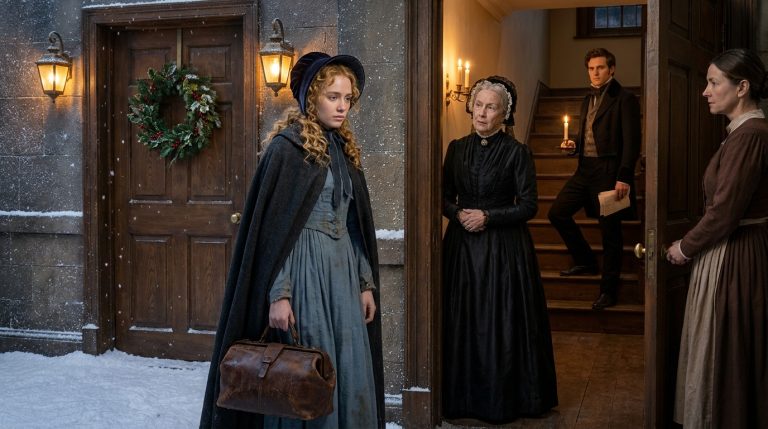
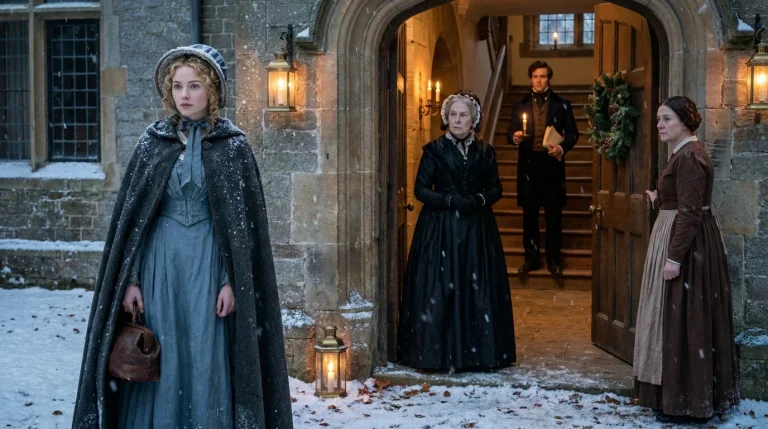
Amelia had believed her mother’s promise was only for her. Now she learned Clara had spent her final years trying to help other girls whose families had no influence. The twist changed Amelia’s understanding of her mother. Clara had not merely secured her daughter’s future; she had tried to create a path for children who would otherwise be trapped in service.
THE PUBLIC READING
At a county meeting, the solicitor read the trust deed, the false withdrawal, and the witness statements aloud. The Dowager’s allies argued that public disclosure would damage the estate and its tenants. Amelia replied that secrecy had already damaged people who had no voice in the matter. Henry announced that he would sell personal investments to restore the fund and that the estate would no longer control its distribution.
Arthur offered to serve as an independent trustee. Rosalind, after a long silence, confirmed that her father had received money from the Dowager in exchange for helping separate Henry from Amelia. Her testimony shocked the room and ended her family’s claim to innocence.
THE COST OF DOING RIGHT
The repayment placed the estate under financial strain. Henry’s creditors demanded payment, and several fashionable families withdrew invitations. The Dowager accused him of sacrificing generations of work for a servant. Henry answered that generations of work had been built partly on money that did not belong to them. He reduced household expenses and sold a racing stable.
Amelia refused to accept a private allowance. She wanted the trust’s funds placed in a bank with published accounts and a board that included women from working families. Henry agreed. His decision cost him the approval of the society he had been raised to impress, but it gave the trust a chance to serve its original purpose.
THE LETTER CLARA LEFT
A final letter from Clara was found inside the lining of the music cabinet. It was addressed to Amelia and written shortly before her death. Clara explained that she had refused to let Beatrice’s promise become a chain around her daughter. She wanted Amelia to be educated, independent, and free to marry for affection rather than survival. She also warned that the Ashbourne family might one day offer wealth in exchange for silence.
Amelia read the letter alone. Her mother had anticipated the very choice now before her. The letter did not tell her whom to love. It told her never to surrender her judgment for the comfort of a powerful household.
ARTHUR’S REAL QUESTION
Arthur returned with the second dance card and finally explained his purpose. He had not come to propose marriage. He had come to ask Amelia to become the first director of a new school funded by the restored trust. The school would teach reading, arithmetic, music, and bookkeeping to girls from working families. He believed Clara’s work deserved to continue.