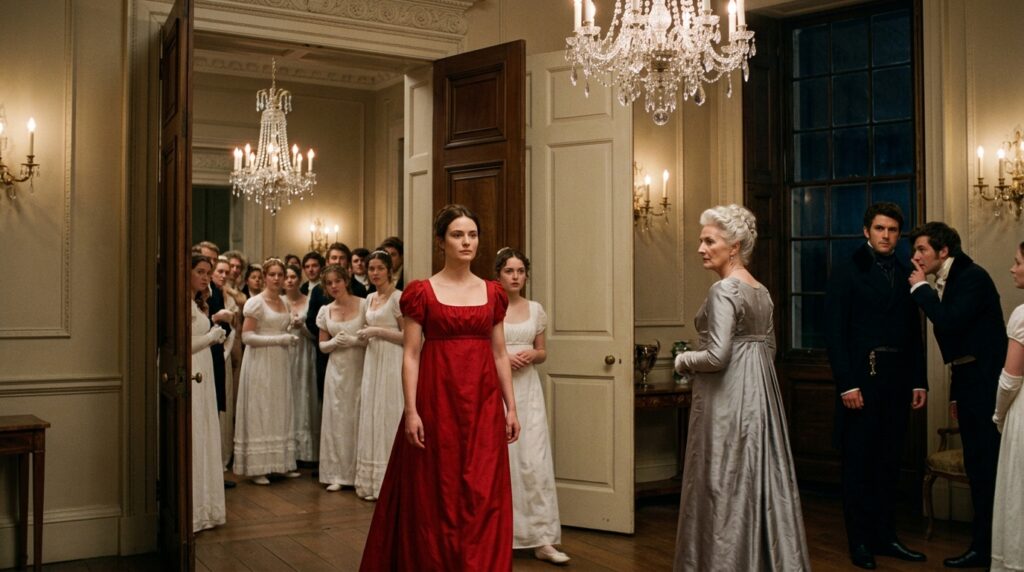
“The young ladies are requested to appear in white.” Thea read the line aloud twice, the second time slower, as though the words might change if she gave them room. Then she held the card out across the breakfast table so that her mother and her sister could both see it. It was thick and cream colored with a border of gilt. It had come up the lane that morning in the hand of a footman who had looked at the Winton cottage the way a man looks at a puddle he must step around.
The Dowager Duchess of Rookhope requested the pleasure of Miss Thea Winton’s company at Blackwind on Midsummer Eve. There was to be dancing. There was to be supper. And the young ladies were requested to appear in white.
“Everybody knows what it means,” Thea said.
Her cheeks were pink.
“The Duke has come home from London, and his mother means to find him a wife before the hay is in. They are saying in the harbor that she has asked every girl from here to the cliffs at Lyme.”
She put the card down very gently beside the butter dish, the way she might have put down a bird’s egg. Their mother pressed a hand to her chest and said nothing for a long moment. Then she said that it was very kind of Her Grace, very kind indeed, and that she was sure she did not know how they would manage it. Alma knew.
She had known before the footmen reached the gate. She sat at the end of the table with her hands in her lap because her hands were not fit to be seen at breakfast. They were stained to the wrist. The left was the dull rose of madder, and the right had a bluish shadow in the creases of the knuckles, where the woad had not quite washed away.
She had been down at the vat since first light. Outside the weather had broken in the night. For 3 weeks the sky over the coast had been low and wet, and the hay had stood uncut in the meadows, while the farmers looked at the clouds and swore. This morning the sun had come up hot and white over the chalk, and every field in the valley smelled of grass.
“Mama cannot walk up that hill,” Alma said quietly. “I will go with Thea.”
Their mother looked at her with relief and something else, something closer to apology. Alma was 23. She had been the elder sister for so long that she had stopped being a young lady in anyone’s mind, including her own. The card said “Miss Thea Winton.” It did not say “Miss Winton.”
Nobody in the village would have thought it odd. Alma was the quiet one, the sensible one, the one with the stained hands who went down to the shed by the stream every morning and came home every evening smelling of roots and wet wool. She was not the one anybody invited anywhere. There was a single white gown in the house, and it was Thea’s. It was a muslin that had been their mother’s, taken in and let out, and taken in again, and it had been washed until it had gone as soft as a handkerchief.











