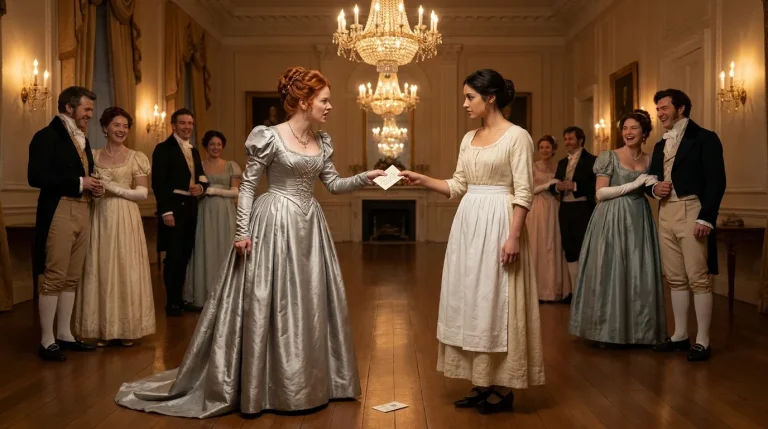
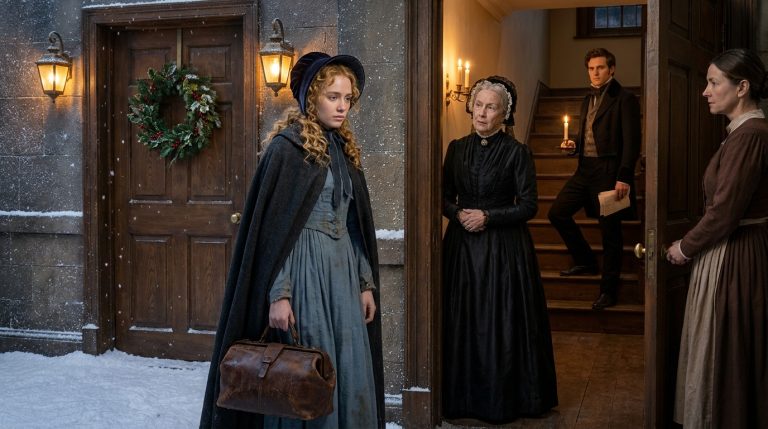
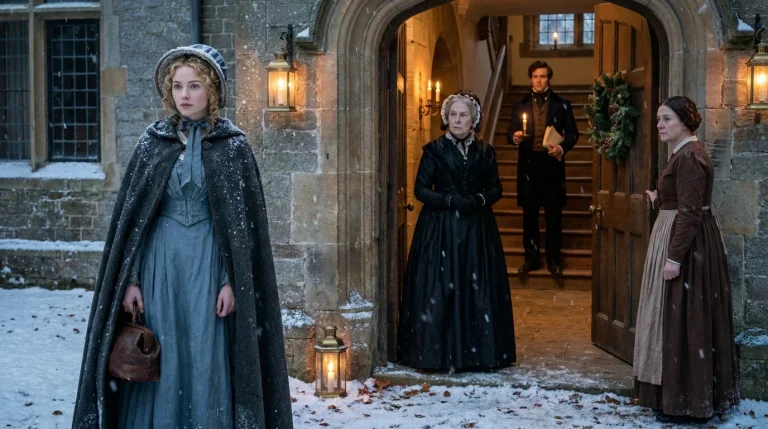
The official story said she had disgraced the family by eloping with a tradesman. Oliver had never believed it. Nora stared at him, unable to reconcile the seamstress who raised her with a noble daughter whose name had been erased. The Dowager demanded that Oliver stop speaking, but his recognition had already changed everything.
The Dowager Duchess summoned Nora to her private sitting room. She offered money, a cottage, and a reference that would secure Nora a respectable position elsewhere. In return, Nora must leave Wrenford and never repeat Oliver’s claim. Nora refused. She said she had spent her life being told her mother was nobody; she would not accept payment to keep believing it.
The Dowager warned that a servant could be ruined by a single word from a duchess. Nora answered that her mother had been ruined by silence already. Sebastian entered before the Dowager could dismiss her. He asked his mother to speak to Nora as a person, not as a troublesome servant.
The portrait’s backing had loosened when Helena stamped on it. Oliver noticed a narrow fold of paper beneath the old canvas. It was a letter written in Margaret’s hand, addressed to the Dowager’s late husband. The letter said Margaret had refused to marry a man chosen to settle the estate’s debts. She had been promised a small trust and permission to leave, but the promised money never arrived.
She wrote that she was carrying a child and feared the family would deny the baby’s name. The letter ended with a request that the child never be punished for the choices of her parents. Nora read it with shaking hands. Her mother had known she might grow up without a name.
Margaret had left Wrenford in 1796, not with a lover as the family claimed, but with a young schoolmaster who helped her reach York. She married him quietly and took the name Bell. When he died, she supported Nora by sewing and mending clothes.
She never told her daughter the full truth because she feared the Vale family might use the child to recover the trust or silence her permanently. The letter revealed that Margaret had not rejected her family; she had escaped a marriage arranged for financial convenience. Her poverty had been the price of refusing to be traded like property.
The Dowager admitted that Margaret had been offered a marriage to Lord Ashcombe, whose estates were heavily indebted. The union would have secured a loan for the family. Margaret refused after learning that the proposed husband intended to control her inheritance. The Dowager said she had acted to preserve the family.
Oliver asked whether preserving the family justified erasing a daughter. She replied that women had always been expected to sacrifice personal happiness for their name. Sebastian answered that this was precisely why the name had become rotten. Nora listened, realizing that the cruelty she had suffered was not an accident but part of a system designed to protect property and male authority.