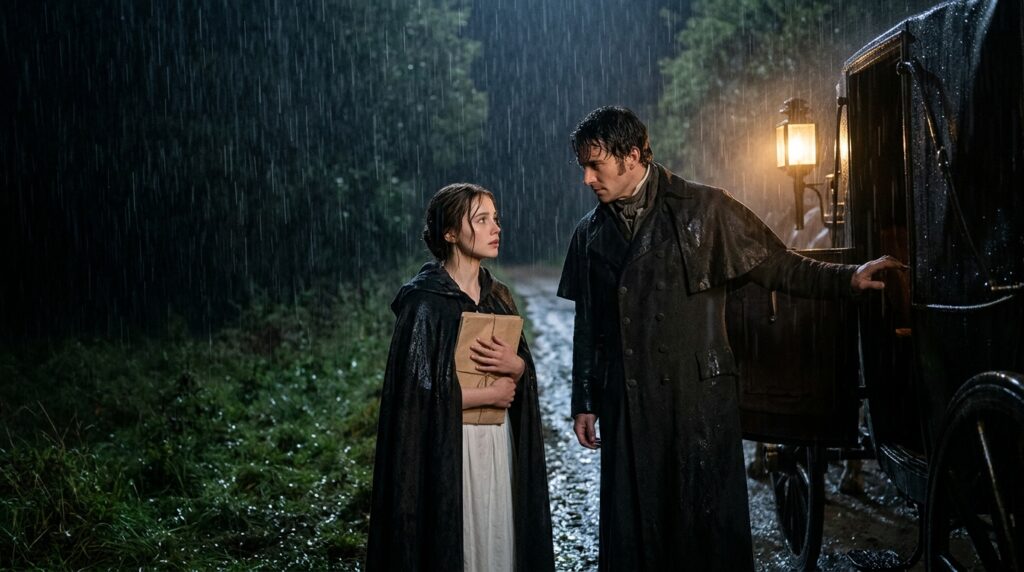
She stepped up onto the bank and into the wet grass to let it by. She put her back to the hedge, because a woman alone on a road at night makes herself small. The lamps came round the bend. Two of them swinging, the light going along the running water in the ruts, and she saw the near horse throw its head at the white of her cloak.
The carriage went past her, and then it stopped. That was the thing she remembered afterwards for the rest of her life, and it was not the words. It was that it went past her and then it stopped. The wheels ran on six or eight yards through the water.
Then the sound of them changed, and the whole weight of it came back on the horses. A voice above her said something short to the coachman, and the door opened while the carriage was still rocking. A man got down into the mud, and he did not send the footman. He got down himself and stood in the rain in a great coat with the collar up and the lamp was behind him so she could not see his face at all.
“You are walking to Nethercot.”
He said it was not a question so she did not answer it as one.
“Yes.”
“At 10:00?”
“The coach goes at 7,” she said. “From the Bell.”
There was a pause. She could hear him considering it. The road, the hour, the cloak that was black with water to the hem, the parcel under her arm that she was still absurdly holding out of the wet.
“Have you money for the coach?”
“I have four shillings and six pence, Your Grace.”
She had not known who he was until the moment she said it. She had known it the way you know the weather is about to change. There was only one carriage on that road at that hour with two men up behind. There was only one house at the end of it, and she had heard the name for 3 weeks at Oborn in a particular tone of voice, the tone people use for a man who has stopped coming to dinner. He did not correct her.
“There is an inn at Nethercot,” he said.
“There is.”
“You have not gone to it.”
“No.”
“Why?”
She was very tired. That was her only excuse for what she said, and she said it plainly into the rain to a stranger who was a duke.
“Because I have four shillings and six pence, and a bed at the Bell is a shilling. If I take a bed tonight, I cannot take the coach in the morning. And if I cannot take the coach in the morning, I do not know where I am to go at all.”
She shifted the parcel higher under her arm.
“I have been walking since 9. I am not drunk, and I am not running from anything, and I have a character in my dress that says I am honest, though I would not put much weight on it. May I sleep in your barn?”
The rain came down between them. She heard the coachman shift on the box, and she heard one of the horses put a foot down and take it up again. She heard very distinctly her own heart, which had chosen this moment to begin behaving badly now that the words were out and could not be got back.
“The barn is dry,” he said.
That was all. He turned and put his hand on the carriage door and he held it open, stood back from it and waited.











