Foster called before school. The same warning had appeared in another supervised check. April had asked to see Eli’s drawing and offered to let him observe from a safe distance with Renee present. Eli tried not to smile too widely when he repeated the invitation. At school he kept looking at the clock.
His teacher, Ms. Ortiz, saw the diagram under his math paper. Instead of taking it away, she helped him label observations separately from assumptions. She said scientists became useful when they could say, “I don’t know yet.” Eli copied her phrase beneath the drawing and carried it home like a new tool.
On Saturday the hangar owner agreed to a supervised visit, but Deke said he would not allow a child to embarrass his crew.
—
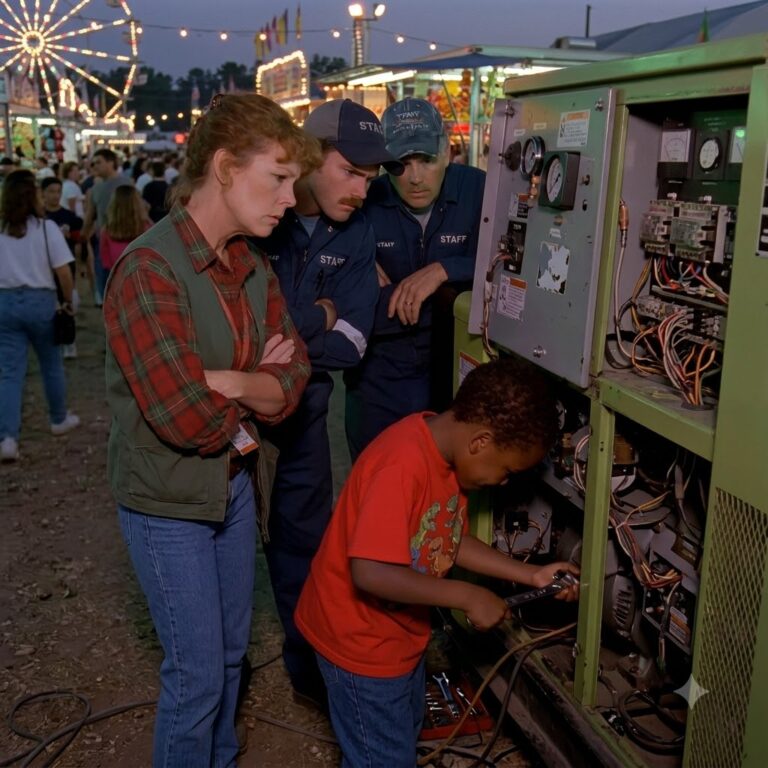
At the hangar a bright stripe on the concrete marked where visitors must stop. Eli stayed behind it. April introduced Luis, a certified technician, and explained that every test would be performed by trained staff. Deke watched with folded arms, amused that grown professionals had invited a twelve-year-old to their meeting.
The adults did not have to be monsters to hurt him. A joke delivered over a shoulder, a door held closed a second too long, a technical question turned into a test of manners: those were enough. Eli could still hear Renee’s warning not to mistake one person’s rudeness for everybody’s opinion. That did not make the embarrassment disappear. It merely gave him somewhere else to put it while he worked. He remembered it clearly.
The crew had already replaced one expensive sensor. The warning persisted. Eli compared two printed readings and noticed a small difference in timing nobody had mentioned. Renee could see him trying not to interrupt, the way he did in classrooms where an answer from him was sometimes treated like a challenge.
April asked him to speak. Eli pointed to the instant a vibration reached the instrument panel and asked if the warning could come from an unreliable signal. Deke barked that a pressure sensor was a pressure sensor. Foster replied that a sensor could report incorrectly if its circuit failed; they needed tests rather than arguments.
Deke listed his twenty years of experience as though they answered the question. April asked Luis whether the proposed check was allowed under maintenance procedures. Luis nodded. For a few seconds the room became a workshop instead of an audience judging a child. Renee felt her shoulders relax.
Then April opened an older repair log and found the same warning recorded before the replaced sensor had been installed.
—
The earlier entry had a date and the signature of a technician who had retired. Deke said it must have been a clerical mistake, but he could not explain why the same two readings appeared together. April asked the team to preserve the history rather than erase it. Mrs. Bennett, the shop owner, frowned at the cost of the unnecessary sensor.