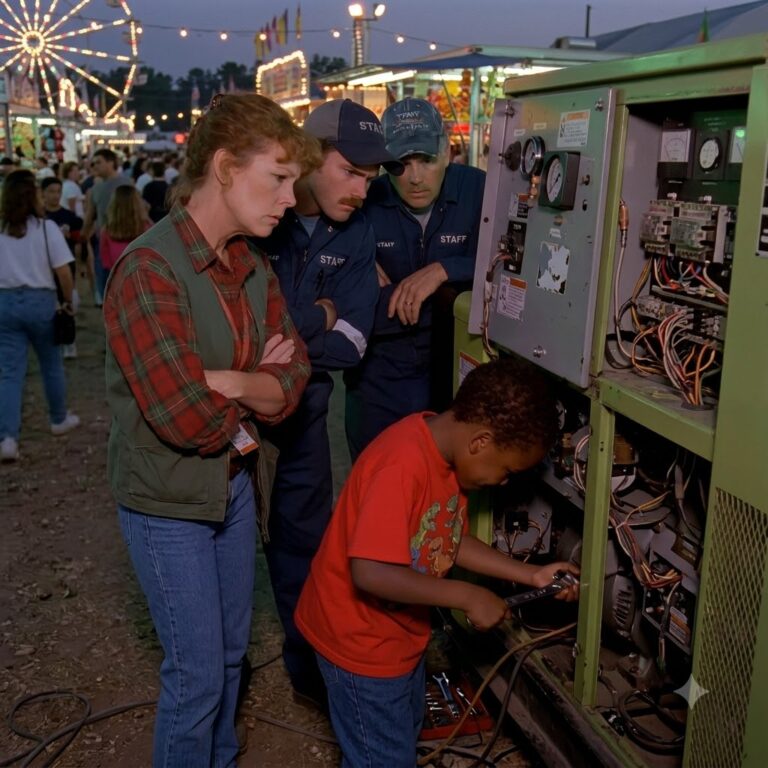
Machines never cared who owned the toolbox. They responded to pressure, friction, timing, and the small ordinary failures that people became impatient enough to overlook. Eli liked that fairness. He also understood that understanding a machine did not give him permission to touch it.
Eli sat beside his mother while the adults argued. A wrong repair could cost more than three months of their rent. He was not pleased about the mistake; he was suddenly aware that the men working around him could lose their jobs if the county ended its contract. His curiosity had consequences, and the realization made him cautious.
Foster brought a safe classroom copy of the wiring diagram and laid it on a bench. Eli traced two lines to a shared connection and asked whether an unreliable point could make separate indicators look as though both had failed. Foster said it was a reasonable possibility but not an established cause.
Deke said the boy was repeating words he had overheard. Eli had a sharp reply ready and swallowed it. He drew the shared point on blank paper, added the two times, and handed the drawing to April. She studied it for a long moment, then asked Luis to test the hypothesis properly. The people standing nearest could finally hear one another without competing to be the loudest.
Luis said they could check it with the system secured, and nobody had to risk a careless shortcut.
—
Monday was full of interruptions. A storm delayed parts, one mechanic called in sick, and the county director asked whether another transport company should receive the rescue contract. April arranged temporary medical flight coverage. Nobody would fly an aircraft merely to protect a deadline, but the shop still felt the approaching loss of business.
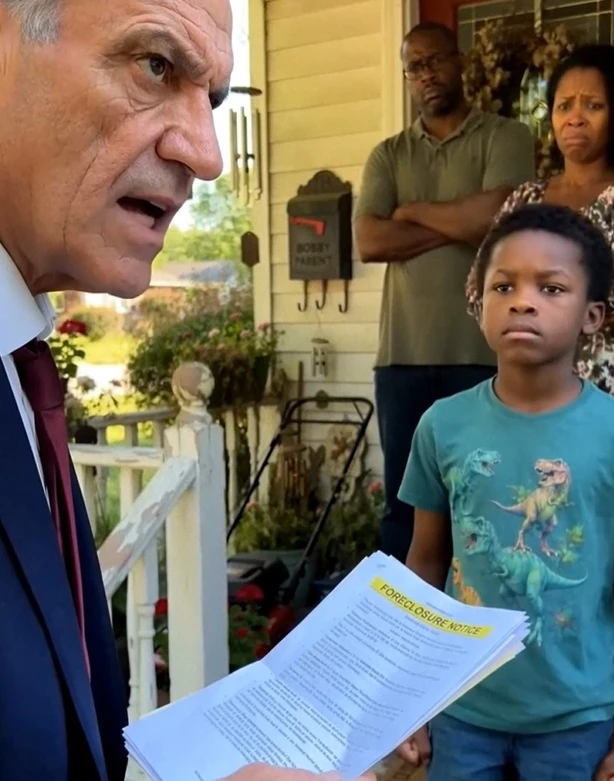
Even so, when money is short, time becomes another bill. Renee counted the miles before her next shift, the groceries left in the refrigerator, and what a missed afternoon could mean for rent. Eli noticed those calculations even when she pretended she was only tired. His wish to help came from love, not from a fantasy of making everyone rich overnight.
At home Renee counted the hours she could afford to spend away from cleaning work. She wanted Eli to have the chance to learn, but she had to keep food in the refrigerator. He offered to stop going to the hangar. She surprised him by saying that his questions were not the problem; the adults’ treatment of him was.
Foster telephoned with a result. The licensed crew had measured inconsistent behavior near the shared point, though additional tests were necessary. Eli wrote the observation in his notebook. He asked what would prove the idea wrong, a question Ms. Ortiz had taught him to ask. Foster said that was exactly how professionals should think.